
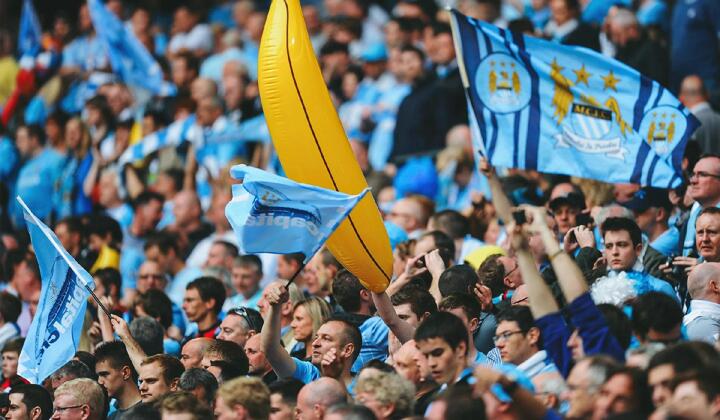
During a Premier League match last weekend, when Liverpool lost to Man City 3-0 at home, Man City fans made a memorable impression by bringing inflatable bananas to show their support for the team. Recently, Man City's official website delved into the history of the bananas and their connection to the club, explaining why fans chose this unique celebration symbol.
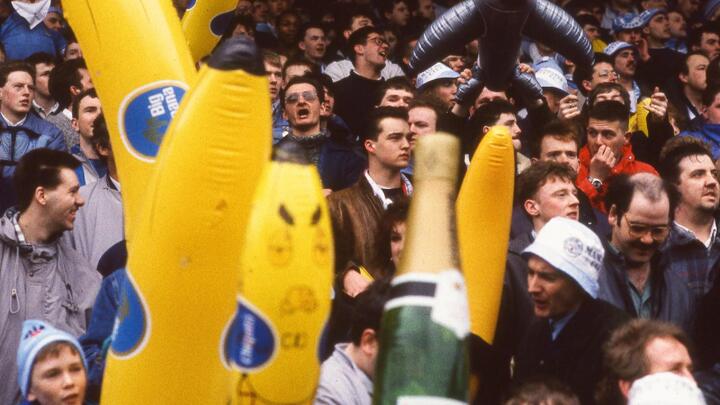
Recalling Man City's away fixture against Stoke City on Boxing Day 1988, the unique tradition of Man City fans bringing inflatable bananas to matches became the focal point. Although the team lost 3-1, the festive atmosphere created by fans was unforgettable.
In the late 1980s, inflatable bananas captured the attention of national, European, and even worldwide media. While there are several plausible explanations for the origin of this trend, it is difficult to determine exactly who started this beloved and genuinely hilarious tradition for Man City or any football club over the years. The Blue Print, a fanzine for Man City supporters, appears to have played an important role in the emergence of this symbol, and if so, Bill Borrows and Frank Newton deserve considerable credit. Another theory suggests that former Man City striker Imre Varadi played a significant role, with believers claiming that some Man City fans in the Kippax stand chanted "Imre Banana" as a play on his name. The timing worked out, so it could have happened, but it's also possible that the wordplay on Imre's name came after the bananas arrived – we may never know for sure.
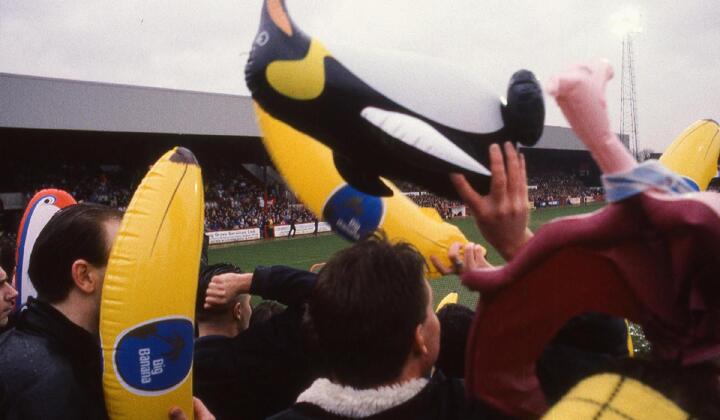
The colorful days of the 1988-89 season, particularly in the Kippax stand or away sections, saw devoted Man City fans deservedly praised by the media for bringing much-needed humor during an otherwise bleak period for the club and football. With English clubs banned from European competitions from 1985 to 1990 and crowd hooliganism becoming an increasingly serious issue, Man City fans, known for their dark sense of humor, dug deep to find alternatives to gloom and negativity. While bananas were a popular choice, many other inflatable toys quickly began appearing – anything went, really!
Who could forget the battle between inflatable Frankensteins and green dinosaurs? E.T.s, giant hammers, and hundreds of other variations. Particularly impressive was the pink flying lizard (ahem!), but I can't imagine who owned that one...
The craze spread, with supporters of other clubs adopting their own themes, including Stoke City with their Pink Panthers, Grimsby Town with their "Harry Haddock" army, and Norwich City with their yellow canaries. It was a colorful and joyful sight, and it all started with Man City.
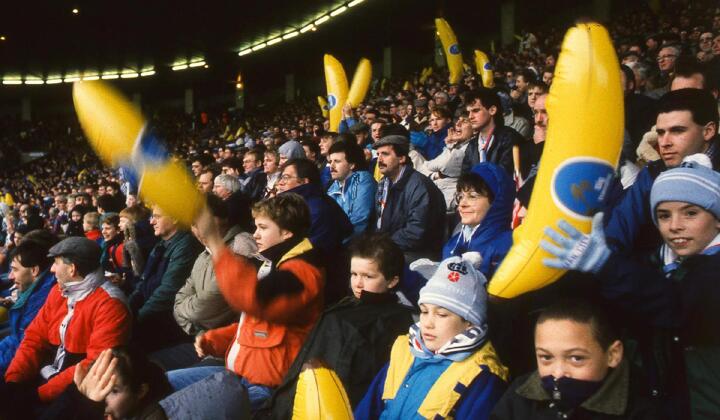
Kevin Cummins, a lifelong Blue Moon fan and regular contributor to the Man City fanzine, and one of England's finest photographers, was invited by the iconic magazine "The Face" to document this fascinating craze. Cummins said: "The guy with the Frankenstein monster was Eli, a friend of mine who always brought an inflated 'Frank' to every match. We used to get stopped by police driving to away matches because he had a six-foot monster in the back seat – sometimes sticking out of the sunroof." "Every week it was a struggle getting him through the turnstiles, and local police would ask to see his ticket and then argue about whether he should be allowed in without one, since he could take up a seat." "Football wasn't like it is today, but Man City fans, with this crazy idea, helped lighten the gloomy atmosphere of matches." "It caught on incredibly quickly and reached its peak when the Man City players actually took the field on Boxing Day at Stoke City carrying giant inflatable bananas, with over 12,000 Man City fans waving bananas in celebration." "It's wonderful to see the banana craze also been passed down to different generations of Blue Moon supporters."
So, let's go back to Boxing Day 1988. Manager Mel Machin had built quite a good young Man City team that was fighting for promotion. Blue Moon entered the Christmas period unbeaten in eight matches, and the difficult away fixture against Stoke City at Victoria Ground on Boxing Day was the highlight of the festive schedule – in fact, it was the only match in the two-week period from December 17 to 31. The match quickly became fiercely competitive; it was a match no one wanted to miss. Stoke City enthusiastically increased our away allocation until around 12,000 tickets were sold. A Stoke City fan recalled: "I've always liked Man City fans, and my brother met a few of them drinking before the match in a local pub, and we had a friendly chat. Many of them came that day – 12,000 traveled south along the M6, many carrying their giant bananas, while Stoke City fans had their Pink Panthers." "The Man City players took the field before the match, throwing inflatable bananas into the crowd, and they were also given a pen area to contain their supporters."
Paul Lake was in Man City's starting lineup that day. Our elegant midfielder and lifelong Blue Moon fan wrote in his autobiography "I'm Not Really Here": "Fancy dress shops were ransacked, wives' wardrobes turned inside out, and Man City's faithful once again illuminated the football world with their unique brand of madness."
"When our team bus pulled up to the stadium that day, it wasn't the usual sea of blue-shirted fans, but a mass of Draculas, Nazis, Mr. Blobbys, Super Mums, Tommy Coopers, a pantomime horse, Bernie Clifton's ostrich, and numerous hairy cross-dressers – complete chaos. Deciding to organize a collective fancy dress party in the Potteries was quite bold; Stoke City could be a dangerous town on match days, notoriously known in the 1980s for their special 'treatment' of away fans."
"To match the party atmosphere, the club asked us to run out onto the pitch with our inflatable toys and throw them into the away stand. We weren't entirely comfortable with the idea; I remember Neil McNab letting out a barrage of Scottish profanities when handed a giant inflatable banana, but we did it."
"If our terrible performance is anything to go by, perhaps we players should have been in fancy dress that day. Eleven jester outfits would have been appropriate for the comedic farce that ended in a 3-1 defeat, a result that certainly dampened the celebratory mood in the stands." "There was a deep sense of shame on the team bus heading back along the M6, and we all lamented our mediocre display."
"Twelve thousand magnificent fans had gone to great effort to create a festive atmosphere, and our performance had truly ruined their parade."
Nigel Gleghorn tried to get the party started, giving Blue Moon the advantage, but Stoke City struck back hard, scoring three goals in nine minutes, with Peter Beagrie and Chris Kamara performing well for Stoke City. Kamara equalized for the home team, and debutant Dave Bamber scored the second goal shortly after. Man City's misery was completed when Brian Gayle clumsily fouled a rampaging Beagrie, and George Berry scored from the penalty spot. Stoke City won 3-1, and despite the disappointing defeat, Blue Moon subsequently embarked on a nine-game unbeaten run that put their promotion push (ultimately successful) back on track. Although Lake was right – we players didn't perform well on Boxing Day 1988 – the fact remains that the fans were absolutely brilliant.
Website AF đã ra mắt! Xem tin tức đầy đủ, bình luận, chi tiết trận đấu và thống kê trên máy tính. Truy cập: www.allfootballapp.com
 Manchester City
Alle Kommentare