
Former Premier League referee Graham Scott has written an article for The Athletic stating that only the use of excessive force combined with brutality is considered violent conduct, and although Rice's action was emotional, it did not warrant a red card. This follows the controversial incident involving Rice in the closing stages of Arsenal's match against Brighton.
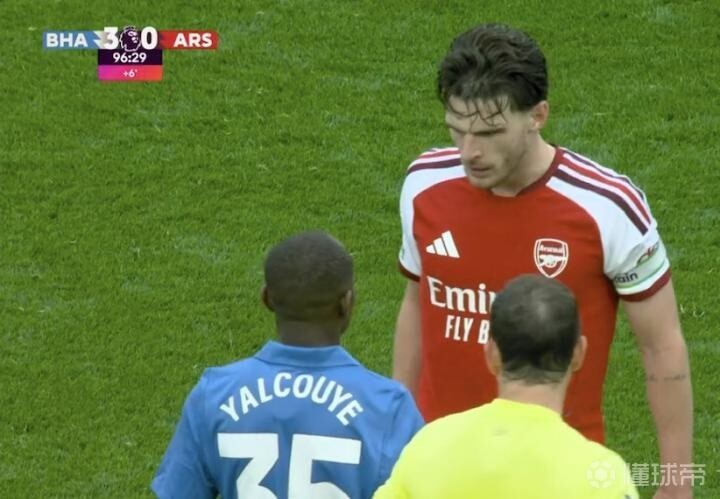
Arsenal had a frustrating afternoon, with Rice losing his composure late in the match.
Arsenal were trailing 3-0 at Brighton. Late in the match, Brighton player Mats Wieffer chased Rice down. After the English midfielder passed the ball, Wieffer bumped him from behind with his shoulder. Rice then rushed toward the Brighton player, made a kicking motion with his right foot, and knocked him down.
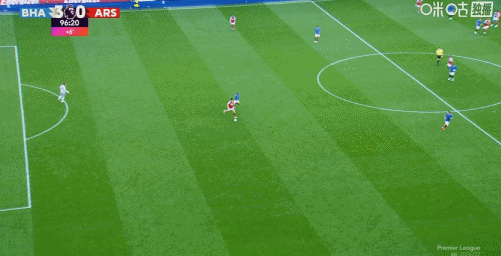
The referee ultimately gave Rice a yellow card, but the decision still sparked debate: did Rice get lucky to avoid a red card?
Many compared this incident to Foden's challenge on Bruno Fernandes in the Manchester derby last weekend, which resulted in a red card.
However, there are key differences between the two incidents. The Athletic outlined the definition of violent conduct in the rules to explain why Rice remained on the pitch while Foden was sent off.
What do the rules say?
The Athletic understands that the Premier League Match Centre (which oversees refereeing for all Premier League matches) agrees that Rice's challenge was not violent conduct and should not have resulted in a red card.
According to the Laws of the Game, violent conduct is defined as a player using or attempting to use excessive force or brutality against an opponent when not challenging for the ball.
Rice's action was deemed impulsive. VAR only recommends a review when an on-field offense meets the standard for a red card, so the video assistant referee did not intervene.
Former Newcastle United and England striker Alan Shearer said on air that the referee's decision was correct.
"Rice just lost his head, Wieffer only gave him a slight nudge," Shearer said. "I think the referee got it right. That wasn't excessive force; he didn't kick him hard."
What's the key difference with the Foden incident?
In the match against Manchester United at Old Trafford, Manchester City forward Phil Foden was fouled by Fernandes near the sideline and fell to the ground; Fernandes then raised his foot and appeared to kick Foden, though his foot was also near the ball.
In retaliation, Foden, lying on the ground, raised his foot and kicked Fernandes in the upper body, causing the Portuguese player to fall. Referee Michael Oliver immediately gave Foden a red card, while Fernandes received a yellow card.
Following the incident, Webb stated that the decision was correct and Foden's action crossed the line into violent conduct. Webb also noted that Fernandes' "frustration kick" should have been a yellow card.
"I agree that Foden received a red card for violent conduct. He kicked Bruno Fernandes in the upper body with force," Webb said. "Joao Gomes of Aston Villa was also sent off for a similar action. These are decisions made by the referee on the pitch.
Looking back at the replay, Fernandes made a frustration kick that caught Foden on the lower back. This action was more emotional in nature and does not constitute violent conduct. Violent conduct must involve excessive force or brutality.
In full-speed replays, his action did not meet the threshold for violent conduct, so it could only be a yellow card, and VAR does not have the power to overturn a yellow card.
If the on-field referee had not seen the incident at all and had not punished Foden, then VAR could have intervened: on one hand, to check whether Foden's action deserved a red card, and on the other, to issue a yellow card for Fernandes' challenge. But because the referee already sent off Foden, VAR has no scope to operate."
Commentary by Graham Scott (Graham Scott served as a Premier League referee for ten years and oversaw more than 100 VAR matches.)
What constitutes violent conduct in football is always a contentious issue. However, in Rice's action against Brighton, I do not believe there is sufficient reason to impose a heavier punishment than a yellow card.
A red card for violent conduct requires excessive force or brutality, neither of which was present in Rice's contact with Wieffer. The action was provocative, impulsive, and completely unnecessary, but it was not brutal.
I suspect the referee did not see the entire incident clearly, but he likely caught sight of both players from his peripheral vision. The fourth official appeared to have a direct view of the entire incident and conveyed relevant information to the referee.
An important detail: he reached for the switch on his waistband, which needs to be turned on to activate the microphone. Fourth officials typically turn off their microphones to avoid constant trivial questions from the substitute bench that would unnecessarily distract the referee.
Whether managing a match live or reviewing footage, referees face challenges in defining violent conduct: such incidents are rare, so there is little precedent to reference.
Last season, three players were sent off for briefly pulling an opponent's hair, and three others received red cards for kicking an opponent in the groin from below, which falls into the category of action that Foden committed in the Manchester derby.
Following the rule review this summer, the standard for punishing brief and accidental hair-pulling has been relaxed; however, there is now general consensus in football that actions like Foden's should result in an immediate red card. We await the latest findings from the Independent Match Incident Review Panel this week.
Over the past year, only one incident slightly similar to this has occurred: a player deliberately tripped or kicked an opponent who was already moving away. Estêvão of Chelsea brought down Gudmundsson of Leeds United with far greater force, yet he only received a yellow card.
Diterjemahkan oleh AI.
Situs web AF kini hadir! Lihat berita lengkap, komentar, detail pertandingan, dan statistik di komputer Anda. Kunjungi: www.allfootballapp.com
 Arsenal
 Manchester City
 Brighton & Hove Albion
 Declan Rice
 Phil Foden
 Malick Yalcouyé
Todos los comentarios