
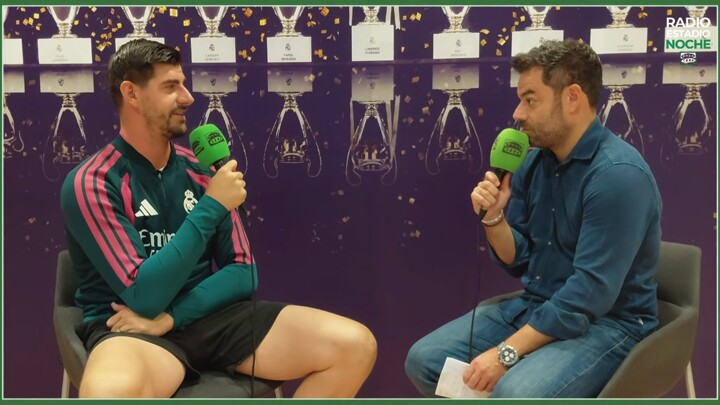
In the third part of this exclusive interview, Courtois discusses the changes in Mourinho, his attitude towards public interviews, and the story of his encounter with Mourinho during the 2014 Champions League semi-final when he played for Atletico Madrid.
What kind of person is Mourinho? How do you feel about Mourinho now?
Mourinho is as good now as he was when I knew him at Chelsea, though his coaching philosophy might be a bit different. After all, 12 years have passed, football is constantly evolving, and as a coach, he naturally progresses with it. I think he might be calmer in his daily life now, and he's clearly more composed when dealing with the media.
But internally, he might also be a bit more peaceful than before. However, on the pitch, he's still very demanding, and in tactical meetings, he's still very strict. He still says whatever is on his mind, just like in the past. I think he's more mature and composed in front of the public now, and he has more experience. He might not get as easily agitated as he used to.
I mentioned on a show before that I feel the current Mourinho might cherish the opportunity Real Madrid has given him again even more. When he first came to Real Madrid in 2010, he had just won the Champions League with Porto and Inter Milan, and he referred to himself as "the Special One." Now, many years later, the best club in the world has opened its doors to him again. Perhaps this experience has made him different.
That's possible. But I still believe that people change with age. I myself am not the same as I was 12 or 13 years ago; I'm much calmer now. I remember there were some things that used to make me incredibly angry, and it's hard to believe now. For example, during training, if I felt I could train more, or if someone wasn't doing a certain drill well, I would get very angry.
Now I think twice before I get genuinely angry. The team went through a difficult period last year, and I rarely got truly angry. But if I do get angry, I think everyone subconsciously thinks, "Oh no, if even this guy is angry, then something serious must have happened."
I don't think you can always be shouting and yelling, because if you do, people will just let it go in one ear and out the other. I've always been quite direct and clear in what I say.
We've always felt that when you're interviewed in the mixed zone, you're able to reflect on things immediately after a match in a way that we can't, and it's often impressive. Is this related to your perspective as a goalkeeper observing the game?
It might be related. I think I've always been quite genuine and specific, and often able to view matches quite accurately. Of course, I think the most important thing is to be realistic. Sometimes, there are things that need to be protected internally for teammates and the team. When I'm interviewed in the mixed zone, I certainly wouldn't attack my teammates or harm the team. I just try to state the actual situation at the time, that's all.
Sometimes my judgment of a match can be wrong too. For example, in the semi-final we lost to France, we were down 0-1, and in the last 10 minutes, Mbappe kept wasting time on the wing. I was so angry at the time that I said some impulsive things to the French media after the match, calling it "anti-football." To this day, they still joke about it in France.
Later, Mbappe even brought up that match with me. But it's actually normal; when you're leading 1-0 in a World Cup semi-final, you'll naturally try everything to run down the clock. It's just that losing a World Cup semi-final at that time was incredibly frustrating for me, and I was only 26, quite young. When you go to the mixed zone or face quick interviews right after the match, you're still emotional, so it's inevitable to say some exciting things.
But I always try to be truthful, and first and foremost, self-critical. If I make a mistake, I'm the first to admit it and will say it directly, because only by being honest with yourself can you be honest with others.
Does admitting mistakes make you seem more vulnerable, or does it make you stronger?
For me, it doesn't make me feel more vulnerable. For example, in the Copa del Rey final two years ago, I did make a mistake, and the opponent equalized. Perhaps we ultimately lost the championship because of that error of mine. Since everyone saw it, and I saw it myself, I have to take responsibility; there's no need to make excuses.
Sometimes, of course, you can explain why you made a certain move or why it didn't succeed, but sometimes it's just a mistake. And for a goalkeeper, such mistakes often cost more than a striker's mistakes.
Do you still remember your initial story with Mourinho? After Mourinho left Real Madrid, he joined Chelsea, and in the 2013-14 season, Chelsea reached the Champions League semi-finals. At that time, you were Atletico Madrid's goalkeeper, and you were on loan to Atletico from Chelsea. Mourinho tried to prevent you from playing, arguing, "How can a Chelsea goalkeeper stand in front of the goal of a semi-final opponent?" But you wanted to play, and eventually UEFA supported Atletico, allowing you to participate in the match. Mourinho could never understand this. That summer, you returned to London. At the time, he was acting in Chelsea's best interest, naturally hoping Chelsea would reach the final. Just like your frustration after losing that semi-final to France, he might have felt something similar at Chelsea then. I remember you mentioned in an Amazon documentary that he didn't even come to greet you after the match, and you didn't meet again until that summer.
Yes. Later I went to the World Cup, and I remember we might have talked on the phone afterward, but I'm not 100% sure. However, it was clear they wanted me back at Chelsea. After the World Cup, I had to start pre-season training in the Netherlands. Later we talked again, and my father was also present. He told me: "If you train well and play well, you will play." For me, continuing to get game opportunities was very important, of course. Ultimately, you have to earn your place through performance.
After all, Petr Cech was still at Chelsea then. If Mourinho truly held a grudge because of what happened before, he could have easily benched you for a year and told you, "Now you'll know what playing means."
Of course, he could have theoretically done that. But I still had one year left on my contract after that, so in the worst-case scenario, if things didn't go well, I could leave a year later. Of course, my dream was to play there and win the Premier League, so I always worked hard for that.
And you ended up winning two Premier League titles.
Yes. Cech also ended up helping me a lot. That experience under Mourinho also made me stronger in many ways. I was only 22 at Atletico then, and I didn't think much about playing that semi-final.
But if you put yourself in Mourinho's shoes, you can understand his thinking.
Of course. Given his desire to win, how could he not think that way? That's just how it was. He said he couldn't understand why a Chelsea player would play for Atletico. But UEFA was also clear at the time that I should play, and I couldn't claim to be injured unless I truly was. In the end, I played, and the match result was what it was.
Did you enjoy your time in London? What did Mourinho leave you with from that period?
He's very direct, a winner who just wants to win. He also likes to provoke and challenge you. When he sees you getting a bit complacent, he'll bench you. One time he benched me, and Cech made a brilliant save. He even went over to celebrate with Cech specifically to provoke me a little. The next game, I made six brilliant saves, and we ended up beating West Ham 1-0, and everyone was happy. That's how it is.
I think football should have this kind of internal competition. You can never get comfortable in your position and think, "I'm definitely playing anyway." In my opinion, football should be like this: you know that if you don't perform well, you could lose your spot any day. This high demand is also what we need to continue winning championships now.
Cech was a great backup.
Yes, excellent.
If 45-year-old Courtois found someone competing with you for the starting goalkeeper spot, do you think you'd handle it the way Cech did back then?
Absolutely. But the situation back then was actually a bit different. Cech was 32 at the time. If you told Cech two years prior that the club might bring in another excellent goalkeeper, or that an excellent goalkeeper was returning, then he would certainly be ready to compete for the starting spot. But he also understood that from the club's perspective, Chelsea at the time leaned more towards me. As long as I could maintain my competitive level, that would naturally be the case.
If I can maintain my level, I know that as long as I do, the coach will eventually play me. He understood that too. But he was never bad to me. He gave me a lot of advice, helped me in training, and also motivated me. Because if he trained well, I also had to train well. But sometimes, after I had a bad game, he would also protect me; he would be there to help me. I think that's very rare.
I also learned a lot from him. If one day the team signs another goalkeeper, and there might be two people competing for one spot, I will always do my job. Even in the season I had my knee injury, if I didn't return to my best form after recovering, and Lunin ended up playing in the Champions League final, I would still be there to help him. I would never show a bad attitude or sulk because that doesn't help teammates. If you want to be angry, you should talk to the head coach, not another player. After all, the other player is not at fault.
So I've always viewed the direct competition among goalkeepers this way. It was the same when I competed with Mignolet and other goalkeepers in the national team. Ultimately, I think the relationship between goalkeepers is very special because we might only have two, three, or four people training together.
AF's PC site is now live! Browse full news, comments, match details and stats on your computer. Visit: www.allfootballapp.com
 Belgique
 Chelsea
 France
 Real Madrid
 Atlético Madrid
 Petr Cech
 Simon Mignolet
 José Mourinho
 Kylian Mbappé
 Andriy Lunin
Tous les commentaires