
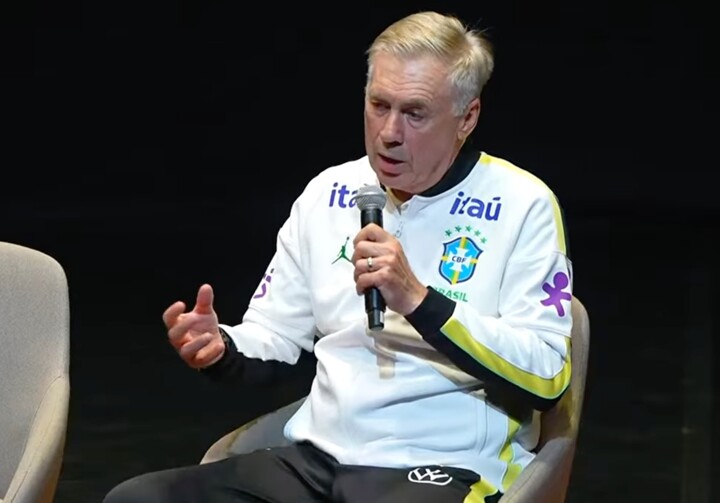
Before the second friendly match between Brazil and Australia, Ancelotti gave an interview, discussing the criticism after the 1-1 draw in the first match, the development of young players, and the future goals of the Brazilian team. This is the second part of the interview.
First part of the interview
Australia held a grand event to welcome the Brazilian team, and it seems the Brazilian team receives such a welcome wherever they go. In this new cycle, will other teams treat matches against Brazil as a final? Also, do you need to make the Brazilian players understand that winning is not just about skill, but also requires the same intensity as the Australian team? Australia played like it was a final, while Brazil always seemed to play like it was a friendly. Do you need to change the players' mentality and make them treat friendlies like finals?
Neither the coaching staff nor the players think, "We are just here to play a friendly." We represent Brazil, a country that carries immense weight in the world of football. This jersey also carries significant weight. For us, there are no so-called friendlies. Whether it's a World Cup match or a game against Australia, we treat them all the same. Because we represent the greatest team in football history.
You just mentioned striving for results and also giving players playing time. Does this mean that at certain stages, besides striving for victory, Brazil will also prioritize giving opportunities to some players? For example, Breno Bidon, Gabriel Bontempo. Is it sometimes more important to give them experience than to not try new players at all and win a game at all costs, just to respond to external pressure?
The top priority now is to develop a new generation of players who can play for Brazil in the upcoming Copa América and World Cup. This is our priority. Perhaps these 26 players currently called up are not the 26 strongest, but we must do something for the future.
We need to keep a close eye on those young players who might represent Brazil in the future. In the past, if a player wasn't playing for his club, I might not have called him up. But now, if we believe he can contribute to Brazil's future, I will call him up even if he isn't currently playing for his club.
When you first took over the Brazilian team, I asked you how passionate Brazilian fans are. Nearly 500 days have passed, and you must have experienced this passion from both positive and negative perspectives. Nowadays, some fans have less patience and demand very high, sometimes even excessive, performance and results from the team. I know not all fans think this way. Many still believe in the team and are enthusiastic and hopeful for the future, but unfortunately, they seem to be a minority now. I'd like to ask you to take this opportunity to speak from your heart, not to reporters or the people here, but to the fans who will wake up at 7 AM tomorrow to watch Australia vs. Brazil. Even though they lack confidence now, they still dream of Brazil regaining its prominence. What would you like to say to them?
We are working hard to make Brazil a protagonist again. Coaching the Brazilian team comes with very high expectations from the outside. Here, you have to win the World Cup; you can't just aim for a top-four finish. Looking back at my career, I can't remember a year when external expectations weren't high. Expectations should be high, and we must do our best to do our job well.
As an athlete, I have always believed that a difficult road leads to a beautiful end. To lead Brazil to that end, what is the most difficult decision you have had to make? We all know it takes time and effort. Where do you hope to take the Brazilian team in the next two or three years?
I think we have to take it step by step. The generation of players who participated in the 2018, 2022, and 2026 World Cups is gradually reaching a time of renewal. We need to develop a new generation of players, while also considering retaining some from the previous generation: based on their age, they still have a chance to participate in the next World Cup.
Now is an exciting and interesting phase where we can observe seventeen, eighteen, and nineteen-year-old young players. We've seen many very talented players, and we hope to have the opportunity to help them grow faster.
Brazilian football has a tradition: whenever the Brazilian team plays, fans expect the team to play beautifully, bring them joy, and make them smile. When will fans see the Brazilian team under your leadership play that enjoyable, vibrant, Brazilian-style football? Or should fans be told now that they won't see such games for a while, and the goal is to achieve it in the Copa América and World Cup?
I think it's natural for both us and the fans to want to see Brazil play well and win games. I don't think Brazilian fans were satisfied with the way the 1994 team played. That team was very solid and won the World Cup thanks to Romário's talent. Playing beautiful football? Of course, we have that capability, and we have players who can play beautiful football. However, I think winning games is equally important.
You just talked about criticism and team performance. A large part of the criticism from Brazil once again points to the team's lack of midfield control. Brazil also encountered this problem in last Friday's match. Tomorrow, the team will field an extra midfielder. Do you hope to use the existing players to make Brazil play with more control and reduce transitions between attack and defense? Is this an issue you are concerned about? Or do you think counter-attacking is more suitable for the team?
Controlling transitions between attack and defense is certainly very important. Against Australia, I think we didn't give them opportunities for counter-attacks. Even with four attacking players up front, the team maintained balance.
Perhaps using three midfielders could make the team more balanced, but it might also make it harder for us to create chances. Against Australia, we created many chances but didn't convert them; our shots weren't accurate enough. It depends on the specific situation. However, against teams good at defensive counter-attacks, controlling transitions between attack and defense is especially important. You can do this with three midfielders, or you can do it while fielding four attacking players. In the first match against Australia, we didn't give them any counter-attacking opportunities.
The team has had several training sessions, played a few matches, and trained together for a while. So far, who has positively surprised you? In your opinion, what is the best change in the team right now?
I really like all the young players who have come here. Breno Bidon is very capable; he has performed well in the Brazilian league. Arthur Dias also impressed me, and I hadn't known about him before. There are also a few goalkeepers whom I wasn't familiar with, but they have also pleased me. Honestly, they all gave me positive surprises. I also really like Gabriel Bontempo and Jair Cunha. I want to be direct: Brazil has a future. Despite the external criticism, we still have a future.
AF's PC site is now live! Browse full news, comments, match details and stats on your computer. Visit: www.allfootballapp.com
 Australia
 Santos
 Corinthians
 Brasil
 Carlo Ancelotti
 Gabriel Bontempo
 Breno Bidon
Semua Komentar (4)