
It is a strange time to be a Manchester United fan.
On the bright side, Manchester City are under siege, found guilty by the Premier League of a swathe of charges of financial wrongdoing, labelled the biggest cheats in English sporting history and told that they may be kicked out of the Premier League and stripped of some of their titles.
But it is hard to enjoy the misfortune of another when your own club has declared war on you. And that is the fate that many United supporters feel they are now facing. The opaque perils of state ownership are there for all to see across the city at the Etihad Stadium but a different kind of storm is sweeping over Old Trafford and laying waste to its old culture and traditions.
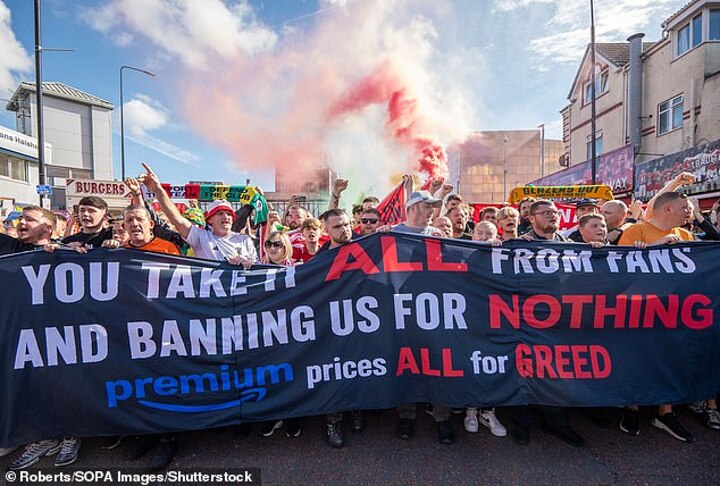
What is happening at United feels like an unregulated form of social engineering. Many see it as a profit grab, piggy-backing a legitimate purge on ticket touts. It is part of a wider attempt to sacrifice loyal supporters by stripping them of season tickets that their families have, in some instances, held for generations and prioritising the fast buck of tourists, corporate attendees and day-trippers.
The latest round of marginalisation of ‘legacy’ supporters under the ownership of the Glazers and Sir Jim Ratcliffe began in July when United launched a ticket touting investigation that led to more than a thousand fans being told that their season tickets were ‘under review’. In many cases, fans were not told what their supposed offences were.
The ‘investigation’ identified 1,617 accounts where ‘unusual activity’ was taking place and last month the club announced it had banned 685 accounts and either sanctioned or warned 464 supporters. The purge, which snared some big-time illegal touts, has also resulted in loyal supporters handing back their season tickets in disgust at their treatment and has created huge resentment among the fanbase.
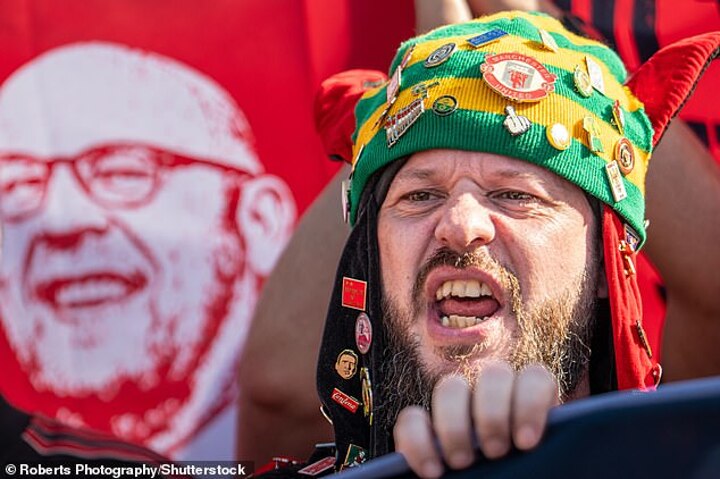
United claimed that the purge had been a triumph. ‘Bans were issued where there was significant misuse of the ticketing system for financial gain,’ a club statement read. ‘This included the operation of organised ticketing networks, which were controlling, selling and distributing tickets from hundreds of accounts.
‘These actions undermine fair access to tickets for genuine supporters and have no place at Manchester United. Our focus now turns to ensuring these tickets are returned to our supporters. All season tickets released through this process will be offered to supporters on the season ticket waiting list.’
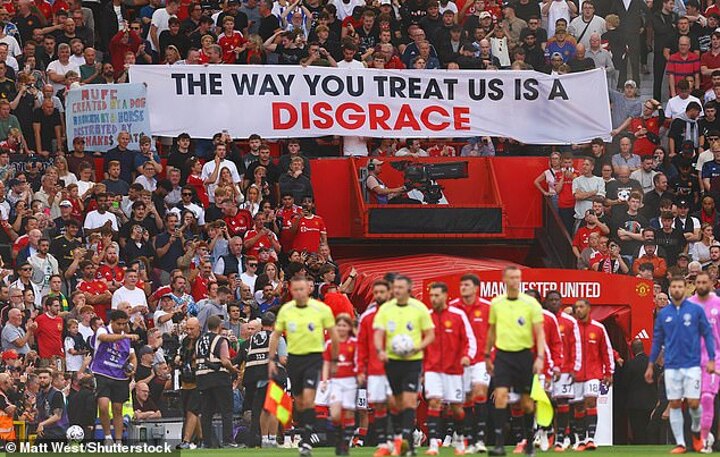
But widespread scepticism and seething resentment remains among the fanbase. Last month, before the match against City at Old Trafford, the players walked out of the tunnel beneath a huge banner that was a message from the supporters to the owners. ‘The way you treat us is a disgrace,’ it said. It was an embarrassing spectacle for Ratcliffe and the Glazers.
The direction of travel at United – and other Premier League clubs – is clear. Analysts estimate that the number of season-ticket holders at Old Trafford has fallen from 53,000 to somewhere closer to 47,000 in the last few years, or down from 71.5 per cent of the 74,518 capacity to 63.4 per cent. Season-ticket holders spend less per match ticket than the club can charge for those coming to single games. Season-ticket holders spend less in the club superstore than tourists and day-trippers.
But in clubs' greed, in their rush for revenue, they are creating a problem for themselves, too. Their unique selling point for the tourists and the day-trippers they are trying to milk is that English football represents the kind of intense, feral, tribal, cacophonous atmosphere that cannot be found elsewhere.
The problem is that clubs like United are fast altering the demographic of their supporters. They are sending loyal fans into exile. And day-trippers do not sing and yell. And tourists do not sing and yell. And corporate clients do not sing and yell. And so the atmosphere at top-flight football grounds in England is dying. And maybe soon, the attraction of paying top dollar to witness an atmosphere that doesn’t exist any more will die, too.
‘Season-ticket holders might have served a purpose in previous eras, providing a guaranteed steady income stream,’ the respected United blogger @carlosartorial wrote on X recently, ‘but now they’re just a nuisance with clubs looking to attract high-spending football tourists instead.
‘Like the World Cup in the summer, the Premier League has moved to a place that’s beyond commercial – it’s cynical, greedy and exploitative. They might try and spin the narrative that they’re concerned with fan safety and ticket touting (i.e. trying to help us), but ultimately this is about weeding us out so they can fleece bigger idiots with deeper pockets.’
And those season-ticket holders that have been purged? What happens to their seats? United say they go to fans on the waiting list. Anecdotal evidence points to other outcomes. Many supporters report seeing different people in a purged seat at successive games, which points to tickets being sold on a game-by-game basis – which, again, is more lucrative in the round for the club.
Last week, I drove up to Preston to meet United ticketing expert and long-time fan Steve Hayward-Jones to discuss the foment at the club, the well of resentment about the manner in which it has prosecuted its purge and an innocent fan culture it appears to be trying to unravel.
‘It’s got to a point where I think everyone is waiting to be banned,’ Hayward-Jones said. ‘It’s like “just ban me and I’ll call it a day, get it over with”. People are expecting it. I could show you so many people who are questioning whether they’ll be going next season. They are saying: “If it continues like this, why am I going?”
‘Matchgoing culture at Manchester United and at other clubs in English football has always relied on flexibility. Mates covering for mates when work shifts change, parents passing tickets to their adult children, and supporters groups ensuring seats never sit empty have been the lifeblood of Old Trafford for decades.
‘By framing informal sharing as a "security risk" and compelling supporters to use only official club resale or donation channels, the club is conditioning the fanbase to accept that you no longer own the right to decide who sits in your seat when you cannot make it. The club wants total control over that inventory, taking your seat back, reselling it to members at elevated match-by-match rates, and squeezing margin at every step.
‘Whatever corporate assurances or spin the club offers, the direction of travel is unmistakable: chipping away at the rights of traditional season ticket holders, ending informal ticket sharing, and paving the way for strict personal attendance mandates that benefit the club's bottom line while punishing loyal fans.
‘This bottom-line focus directly explains the crackdown on general admission season ticket holders. Relocating long-standing fans in the South Stand for hospitality expansions and using an algorithmic crackdown to restrict or cancel accounts all point toward inventory reclamation.
'The arithmetic is simple: breaking up an £874 season ticket (£46 per home league game) into match-by-match member sales yields around £1,390 across the season, an effortless 59 per cent uplift in revenue per seat.
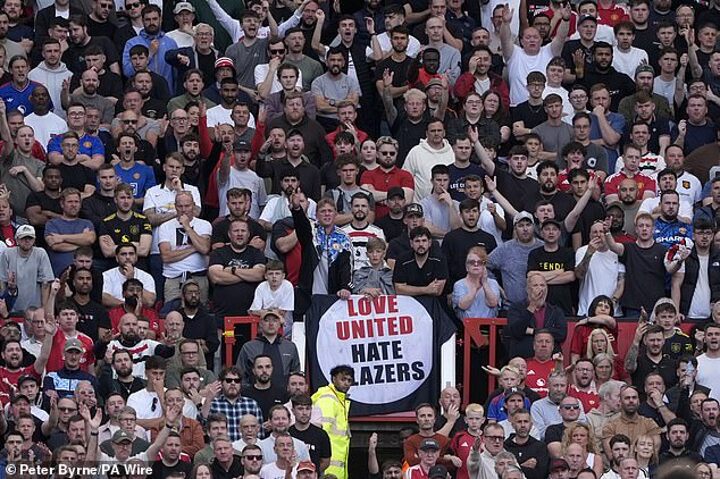
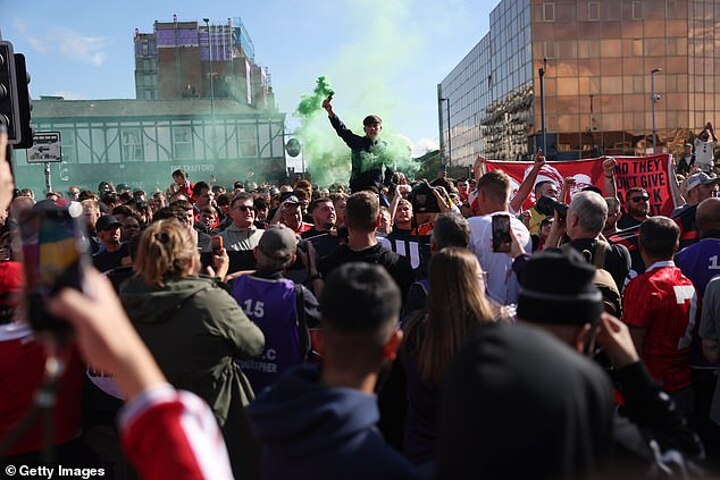
‘By restricting ticket forwarding, targeting informal family sharing, and testing strict attendance traps under the guise of "security", INEOS is dismantling Old Trafford's organic community culture. Rather than treating loyal supporters as the custodians who sustained the club through decades of misrule, the new leadership is treating match-going fans purely as an under-monetised asset to be squeezed for maximum margin.’
Some of the most devoted fans feel they have been victimised. The Portadown branch of the Manchester United Supporters’ Club was hit particularly hard. United’s Northern Irish fans are some of the most dedicated in the base but because of the costs of travel, the practice of forwarding tickets to each other has been commonplace.
‘On July 20,’ Harry Blevins, a season-ticket holder for 34 years, told the Irish Red Devils podcast, ‘31 of our season ticket holders received an email saying their season tickets had been restricted due to some data analysis thing that the club had done. There were a significant number of OAPs among that number.
‘There’s some sort of suggestion we’ve done something they don’t like but they’re not telling us what that is. Three days into the season, they gave me an away ban for a season and suspended me for 12 months for forwarding tickets. I made the heartbreaking decision to hand my season ticket back. It has been a total fiasco.’
Andy Mitten, the founder and long-time editor of the powerful and much-respected fanzine United We Stand, and a moderate but challenging commentator on club affairs, appeared with Blevins on BBC Radio Ulster a few weeks ago to discuss the review that is continuing to cause so much anger amongst fans.
‘The club are adamant this is to weed out ticket-touting,’ Mitten said, ‘but there is a lack of trust from fans towards the club. The mood is pretty low. Fans are suspicious of what comes next. Not everyone wants to move to a new stadium and if there is to be one, fans are worried they might not be able to afford to go to it.
‘There is a trend, not just in the Premier League but at Spanish clubs like Barcelona, where ticket prices are rising sharply for fans who want to come to one-off games.
'That’s where clubs are making their money. And that puts pressure on season-ticket holders who go to every game who pay a lot less than somebody who wants to go to a one-off visit.

‘There is a suspicion that the clubs want to take advantage of more one-off visitors because the demand is there. I have people coming up to me outside the ground when I am selling UWS saying they are from Milwaukee or Seattle and they are perfectly nice people and I ask them how much they have paid for their tickets and it is often £300.
‘And they have bought it from the club. At the expense of who? That is the worry. I have got nothing against people coming to Old Trafford for the first time. Everyone has to go for the first time and there are a lot of similarities with the situation at Liverpool. It stings because it’s horrible for the hardcore fans. There is a feeling among people that their loyalty is not fully appreciated.’
It has got to a point now, a few weeks on, where it is more than a feeling. It is something closer to a conviction.
The blue half of Manchester may be in shock, or denial, about the actions of its owners. The red half knows what its owners are. At Old Trafford, the fans moved past shock and denial some time ago.
 Manchester United
Semua Komentar