
Recently, Xavi sat down for an in-depth interview with Indian podcast host Prakar Gupta. In the first part of this exclusive interview, Xavi discussed his coaching philosophy, Lionel Messi, Lamine Yamal, Cruyff, and his development as a footballer.
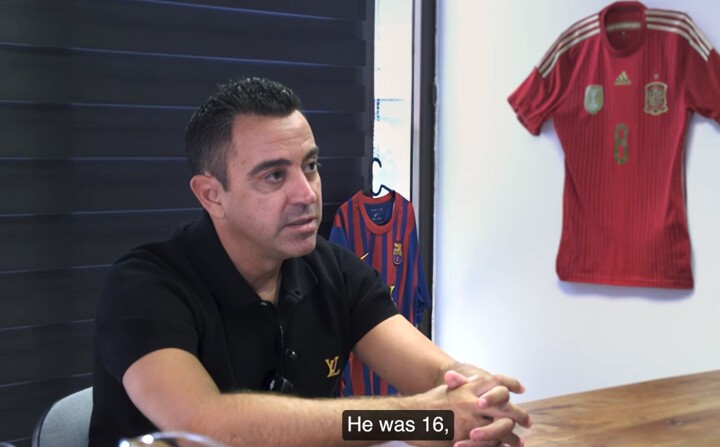
Prakar Gupta: Hello, Xavi. It's great to have this conversation with you. First, congratulations on taking the job as head coach of the Dutch national team.
Xavi: Thank you very much.
Doesn't it feel like a perfect circle?
I'm really excited about this project. Yes, this is a good time. There have been many changes since the World Cup, but this project is truly fantastic. I'm really looking forward to starting this new journey. Right now, I'm preparing everything and closely monitoring the condition of the players. I'm especially happy to be in such a beautiful country. I have a deep connection with this country. You'll remember Johan Cruyff, of course, as well as Van Gaal, Frank Rijkaard, and Ronald Koeman. I have countless connections with this place. So I'm very, very happy.
Do you remember when you first saw young Lionel Messi? What were your thoughts at the time?
We were in the same locker room, and he was just 16 years old. When we were in the locker room, I think we were on a pre-season tour in China or Japan. He was extremely shy, very polite, disciplined as a young man, and a great teammate. But as you know, when he arrived at the training ground, wow...
He was incredible from the start. The moment I saw his first, second, or third training session, we immediately realized he was completely different from anyone we had seen before. It was unbelievable. He was a genius. My assistant coach now, Alegre, told me when Messi was 15 years old: "Xavi, remember the name Lionel Messi, the Argentine player." I said okay at the time, but I had heard such things too many times before. He had to come up to the first team first, and then we would see, I thought, but we didn't have to wait. We witnessed it firsthand. He was absolutely extraordinary, and with his one-on-one ability he could decide matches. I remember him up against Puyol, Oleguer, and Thuram. They were our best defenders, but at just 16 years old, he could do almost anything he wanted against them. He was a genius, and he still has that genius in him.
You also discovered Lamine Yamal and promoted him at Barcelona. Not just Yamal, but Neymar was also a wonder when he was young. I've listed these top players, and of course there are many players who make you think at 16, "Wow, this guy is going to be special." But Lionel Messi took it so much further, to a level of ultimate uniqueness, didn't he? Did he already show potential as a generational superstar back then, or did people just think he was a good player?
No, no, no. If you watched Lionel Messi play or train, you would have known he was on a completely different level. Even if you knew nothing about football, you would have stopped and thought, "Wow, what's happening here—he's dribbling past two or three players." That's really unusual for a 16-year-old. Later, the same thing happened with Lamine Yamal. We observed matches in the youth academy, understood the development of the youth teams, and watching him play in one match, we realized this kid could be the best talent. Of course, it depends on mentality. For example, Ronaldinho and Neymar were both undeniable geniuses, but after that, it depends on their ambition, mentality, and passion for the game. Lionel Messi is the perfect example. He is a genius, but he's also an example to everyone. He works very hard, and the mentality, ambition, and passion he shows to everyone—Leo is the best example.
Do you remember a specific moment when Leo showed his pure self on the pitch and you truly said, "Wow, how is he doing that?"
I remember many matches, really many. You know, I'm the one who controls the overall pace of the match on the pitch. Sometimes, for example, there are days when our entire team plays terribly, performs poorly, and loses the ball frequently for 20 or 25 minutes. Then suddenly Messi appears, boom, he scores a goal, or boom, he creates a free-kick opportunity and converts it into a goal himself. Even when our entire team isn't playing well, we have this trump card in Messi.
Your early football career was shaped by Rijkaard and Van Gaal, but Cruyff was the one who influenced you most deeply, wasn't he?
Yes, I think Cruyff deeply transformed the spirit of football here. First when he came as a player, and especially later when he came as a manager, he changed so many things. The football philosophy he brought to this country, to Catalonia, to Barcelona completely reshaped our perception. He was an absolute genius. His ideas were amazing. Triangle passing, dominant attacking, advocating for an aggressive playing style, and maintaining boldness—all of this was incredible, and he changed everything.
That's what's called Total Football.
Yes, it's a different football culture. Now we can proudly say we are the inheritors of Dutch football philosophy and disciples of Johan Cruyff. We can say that.
As a disciple of Johan's football philosophy, what does this football look like specifically?
I think it's a privilege and the greatest honor. It's a completely different culture, a philosophy of dominating the match and controlling possession. It was very rare at that time. Because from what I remember, everyone in Spain talked about blood, grit, and courage. But when Johan arrived, it was completely different. He was very composed, established order on the pitch, and emphasized establishing order through possession. We had to control the ball, attack, and create many chances. It was completely different. For us at that time, it was like, "Wow, this man is bringing us something new."
Imagine, I wasn't strong enough, fast enough, and I didn't dribble much. If it had been 1970s Spanish football, I would never have become a professional footballer. Never. But under Johan's philosophy, it was completely different. This playing style was perfect for me because I had to think about my teammates' positions, triangle passing, positioning sense, possession, and starting attacks. It was a completely different kind of football. Johan Cruyff didn't just transform Barcelona's spirit; I believe he transformed world football. To this day, people respect Johan Cruyff as a master of sport.
Let's talk about that young boy from Terrassa. How did he gradually become one of the greatest football masters of our time? Perhaps we could start from his childhood at Terrassa or La Masia. What was it like when you entered La Masia at 11 years old? How was your first day?
When my parents told me that Barcelona wanted to sign me, I felt incredibly lucky. From the beginning, our whole family were loyal Barcelona supporters. At the time, my grandfather lived with us, and he was an extremely passionate Barcelona fan. He hated Real Madrid. Yes, that's right, he hated Real Madrid. Imagine living in such a family and constantly following every move, news, and newspaper about Barcelona. My father was also a professional footballer and later became a coach.
For our entire family, football was like a religion. For my brother, sister, and mother too. If I go to my parents' house now, my mother still watches football matches. That's our passion. All of this comes from my childhood. When I was four or five years old, my brothers were also playing football, and 99% of my childhood was spent playing football.
AI 번역.
AF PC사이트가 오픈했습니다! 컴퓨터에서 전체 뉴스, 댓글, 경기 상세 정보와 데이터를 확인하세요. 방문하기: www.allfootballapp.com
 Olanda
 Barcellona
 Lionel Messi
 Xavi
Xavi
 Johan Cruijff
 Inter Miami
 Sergio Alegre
 Lamine Yamal
Tutti i commenti