
A draw might not be the most inspiring result for a new era, but there were still plenty of positives for Sebastien Pocognoli to take from his first game in charge of Scotland.
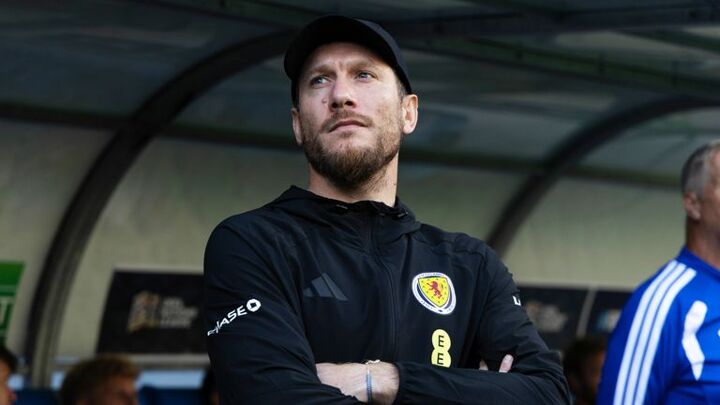
On the surface, 0-0 against Slovenia doesn't exactly scream entertaining. On another day though, Scotland could've either won by four or lost by a couple; such was the nature of the contest.
In the first half they looked vulnerable, but the second completely dominant. So, what exactly did Pocognoli do to change things up for the better, and what does he still need to keep his eye on?
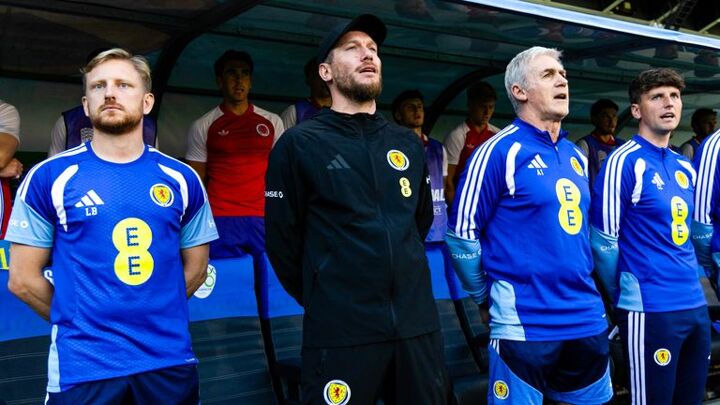
High press creates chances, but leaves Scots exposed
Despite his record of qualifying for more major tournaments than any other manager, the one criticism Steve Clarke repeatedly received during his tenure was that Scotland sat too deep.
Pre-match, Pocognoli made a point of emphasising that his ideology was the opposite. "I try to be a little bit higher up the pitch," he said.
"On the ball we need to have patterns, which is the most difficult part. But off the ball, we need to be solid. That doesn't mean dropping off though; we need to be higher."
What that created at the start was far more exposure to Angus Gunn's goal. In the first 30 minutes, Slovenia had a goal ruled out and missed numerous other chances. All it would take was one ball over the top of the Scotland backline, and they were in.
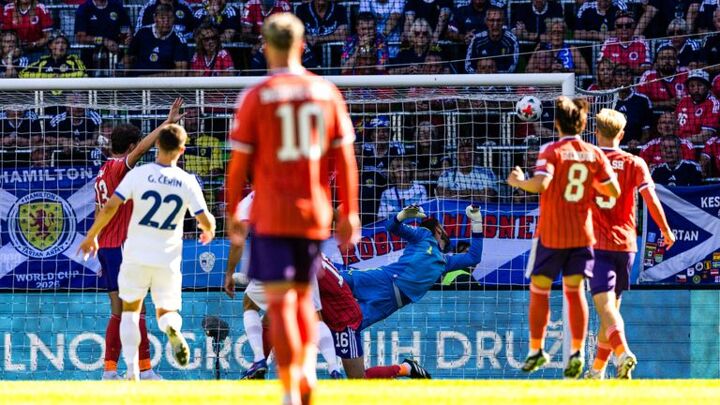
Andy Robertson and Stephen Welsh were caught out several times in particular and it was the hosts' poor finishing that kept them from going ahead in that period.
However, when Scotland did finally get to grips with the game, the benefits of the high press came to the fore. It created a glorious chance which Oli McBurnie squandered and helped keep a chaotic tempo which suited Pocognoli's men and kept Slovenia very much on the edge.
It needs some fine-tuning, but with the likes of John McGinn and Scott McTominay when he returns, there's enough energy and quality to make the most of this change in approach.
A different-looking 3-5-2
Pocognoli's formation was similar to what we have seen from Scotland previously. A 3-5-2. However, it was not a defensive set-up.
Aaron Hickey and Andy Robertson had far more license to get forward and the former picked up some lovely areas when entering narrower positions. The wing-backs' main priority was to attack, something that was rarely the case under Clarke. This was further emphasised when Ben Gannon-Doak came on to replace Hickey in the latter stages in search of a breakthrough.
The right and left-sided centre-backs were also a bit more adventurous. On a couple of occasions, Jack Hendry was allowed to roam almost as far up as the Slovenia penalty area to add more numbers.
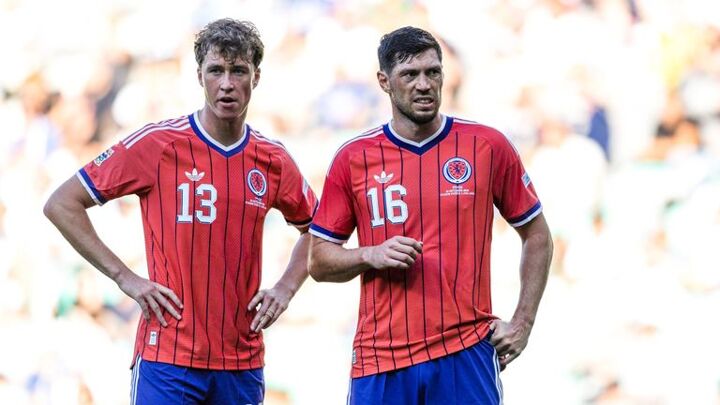
It was also intriguing to see Stephen Welsh operate on the left of the back three. With the left-footed Scott McKenna central, it would've seemed to have made more sense to swap the two around. However, Welsh's passing was key in trying to split Slovenia open. That was most apparent when he managed to slide in substitute Kieron Bowie, who was thwarted by Jan Oblak.
There was a lot more emphasis on Billy Gilmour to pull the strings in midfield and use his technical ability to open up Slovenia after Scotland won back possession in more dangerous areas. And when the game was stretched, John McGinn was the driving force to get the midfield up the pitch.
New chances for a new attack
The front two both had reasons to prove themselves. In Robbie Ure you had a debutant looking to make his mark and in McBurnie you had a man looking for redemption after five years out of the reckoning.
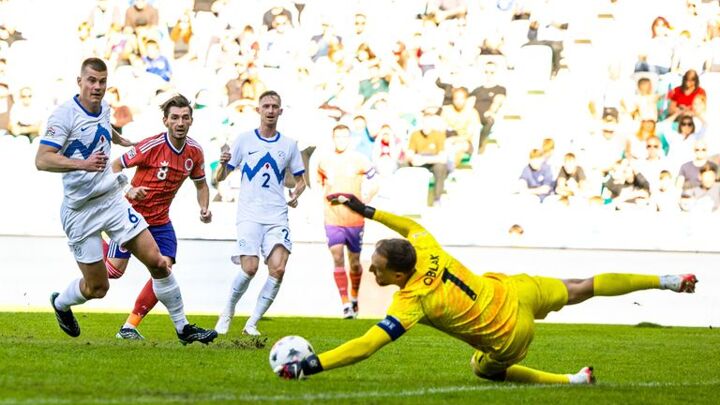
Neither scored, but both could've. Ure hit the post, while McBurnie made a mess of a glorious one-on-one and saw a thumping header kept out at point-blank range by Jan Oblak.
The way Scotland pressed, you could see someone like a Lyndon Dykes, who wasn't in the squad, having a positive impact. But Pocognoli is ushering in a new era with new players. And his front two certainly posed questions and had a couple of moments of nice interplay.
McBurnie especially is a good option for the midfielders to play and run off. In one moment where Scotland won the ball back high up the pitch, the Hull City man became a wall for Gilmour, creating a good opening. That is where he shone and could continue to be a nuisance in Pocognoli's search for high-pressing breakthroughs.
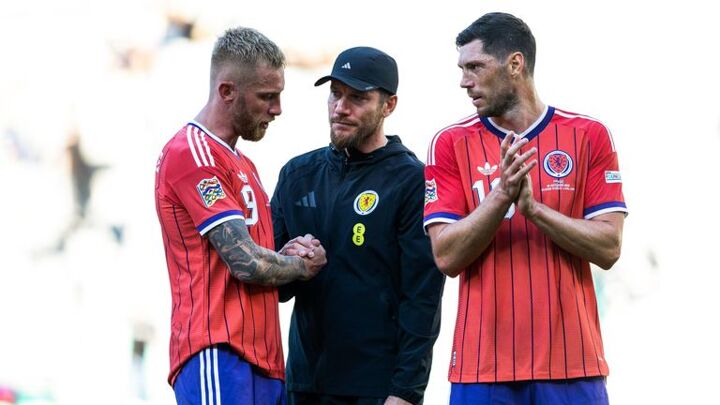
What the players made of Pocognoli's changes
Scotland striker Oli McBurnie speaking with BBC Sport:
"It took us a little bit of getting used to in the first half, the new formation. I thought once we did, we looked really good. We created enough chances to kill the game. We are really disappointed we didn't get the three points.
"I was asked to play a different position and I quite enjoyed it. I like the manager's ideas; we've had some good chats about it already. It suited me in there, but I won't be able to sleep tonight with those chances. It's a tough one but I'd rather be getting into those positions than not getting the chances.
"We had them pinned for a lot of the game. We put them under waves of pressure. The only thing missing was a goal or two."
Scotland striker Stephen Welsh speaking with BBC Sport:
"We struggled to get into the game in the first half. Obviously it's a new style, some fresh faces and a new way of playing. In the second half, we completely dominated the game. At this level, you need to take your chances. But it's something we can improve on. Definitely positives to come from the game.
"The manager told us at half-time to be a bit sharper on the counter-press. We changed shape at half-time to get more control in the midfield and I thought it worked really well for us.
"I've played on the left-hand side for the last couple of years now. I'm very comfortable doing that. As long as you're in the starting XI, that's the important thing."
 Tottenham Hotspur
 Napoli
 Atlético Madrid
 Oblak
Oblak
 Andrew Robertson
 Billy Gilmour
Tutti i commenti