
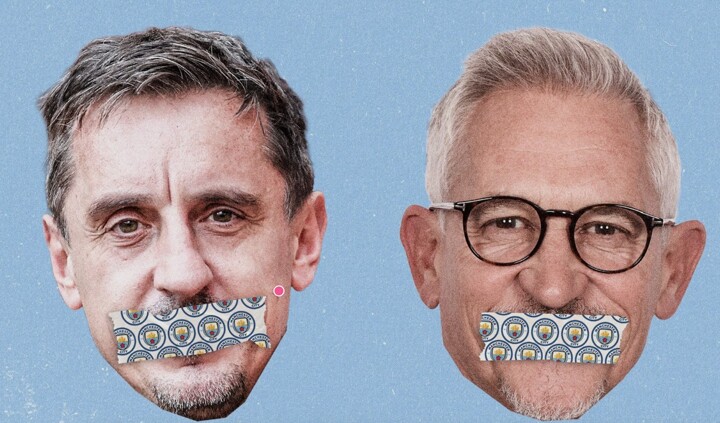
The Telegraph highlights that Lineker and Neville's silence on Manchester City's financial charges exposes persistent patterns in British football commentary. Many former football stars who have become opinion leaders often champion the freedom of expression they claim to enjoy on new platforms. Yet the collective silence from so many prominent football voices on an event of such magnitude is genuinely striking.
«When I travel, when I interview top-level players and managers, when I discover the truth about how the football industry works internally, it's about taking fans on that journey with me, letting them see, feel, experience it firsthand,» Rio Ferdinand, an enthusiastic podcaster, said in an interview with Boardroom last year. «In this era, you can do things that were unimaginable before.»
After launching his podcast, Lineker told the i newspaper: «I feel completely liberated. I no longer have to tiptoe around things or be overly cautious.»
In 2024, Neville discussed television analysis in an interview with The Drum: «At half-time, you've only got four minutes, and they have to be split between three people talking. You're constantly constrained by time.»
Yet this supposed freedom also allows podcasters to choose silence and offer no substantive commentary.
Few would want more football commentary, but this paradox emerged after last weekend's bombshell that 114 of 115 Premier League charges against Manchester City were upheld.
As of writing, top podcasts including «Stick to Football,» «The Rest Is Football,» «The Overlap,» «The Good, The Bad & The Football,» Rio Ferdinand's self-produced show, and «That Peter Crouch Podcast» have all remained silent on the matter.
Part of the reason is the international break, with many football professionals on holiday; for Neville, he may be in what he calls a «brief semi-retirement.»
By contrast, local YouTube creators Mark Goldbridge, Rory Jennings, and Arsenal fan channel AFTV—typically heavily criticised—have collectively produced six videos and two livestreams since the news broke Friday. Even traditional print media, like this newspaper, responded faster than the top commentary figures.
This would never happen in the United States. When major sports news breaks, prominent media personalities quickly launch «emergency podcasts.» «Men In Blazers,» hosted by Britons but operating in the US, understands this local logic well, publishing an episode Friday specifically dedicated to the charges against Manchester City.
This is not to discredit the dedication of former players who have ventured into podcasting. Neville, in particular, works with the intensity of eight people; and Lineker, at 65, is entirely entitled to share his opinions at his own pace. When their scheduled podcasts publish, the content will undoubtedly be worth listening to.
Yet the collective silence from so many prominent football voices on an event of such magnitude is genuinely striking.
ITV's UEFA Nations League broadcast Saturday evening filled this media void. While focus was primarily on the England-Spain match, the second commentary segment was specifically dedicated to discussing Manchester City's case.
Wright spoke passionately about the many historical grievances caused by Manchester City's alleged misconduct; Keane's indignation didn't even match his reaction to a slightly loose press from a Manchester United midfielder. Mata joked: «I never won the Premier League… or did I, actually?»
Perhaps we won't have an answer for him until the appeals process concludes in 2039.
As we approach 2026, one can't help wondering if the much-hyped podcast revolution is merely a false dawn. It promised audiences on-demand, live, direct content without cumbersome intermediaries. Now that even News at Ten accepts online interviews via webcam, it stands to reason that podcasters should be able to respond quickly to major news. Yet shows hosted by former players have failed to do so. It also reminds us that they remain fundamentally part of the entertainment industry.
This incident reflects a shallow trend in British culture that has permeated football media. The public sphere is excessively dominated by celebrity influence, with people stubbornly believing that the most famous former players always hold the best opinions. This system conflates concepts, using celebrity and popularity as measures of expertise.
If you've watched major football events on television across Europe, you'll see a very different model. The common perception is that Italians debate politics all night on Rai 1, and French television only broadcasts Sartre seminars or obscure art films. Yet when needed, they are meticulously rigorous in football coverage: seasoned industry professionals spend hours dissecting matches and major news with analytical precision.
While most post-match analysis on British «Super Sunday» certainly doesn't need to be so elaborate, there are moments when British media shows gaps in coverage—after a dramatic Champions League final, or when confronted with the biggest event in domestic football in over a decade.
Traduit par IA.
Le site web d'AF est désormais en ligne ! Actualités complètes, commentaires, détails des matchs et statistiques sur votre ordinateur. Visitez : www.allfootballapp.com
 Manchester City
 Gary Neville
 Gary Lineker
Tutti i commenti