
According to statistics released by Athletic, the actual playing time in the Premier League has increased compared to last season following the introduction of new rules.

The International Football Association Board (IFAB), which governs soccer rules, introduced a series of rule changes this season aimed at reducing time-wasting. These measures include a rule requiring substitute players to leave the field within 10 seconds.
If a player exceeds the 10-second limit, their replacement is banned from entering the field for one minute. Additionally, referees now conduct a 5-second countdown during goal kicks and throw-ins, and injured players must remain off the field for one minute before returning.
But have these changes actually accelerated the game? Early signs in the Premier League suggest the answer is yes. In the first four matches, the average added time was 26.7 seconds, shorter than last season's 29.2 seconds and the lowest since the 2020-21 season.
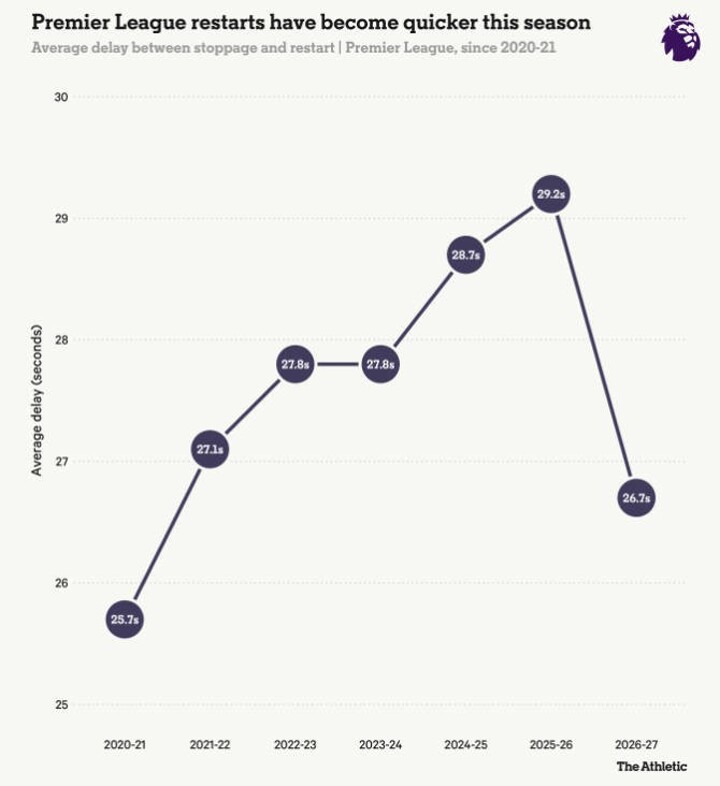
Average Added Time per Season in the Premier League Since 2020-21
This average includes all stoppages, including VAR reviews and delays from genuine injuries, where the new rules have limited impact. The graph below breaks down the IFAB directives regarding free kicks, goal kicks, substitutions, and throw-ins.
Unsurprisingly, substitutions saw the largest reduction overall, down 12 seconds from an average of 76 seconds last season. While the process itself takes over a minute, the image of exhausted players leisurely leaving the field while greeting individual spectators appears to be becoming a thing of the past.
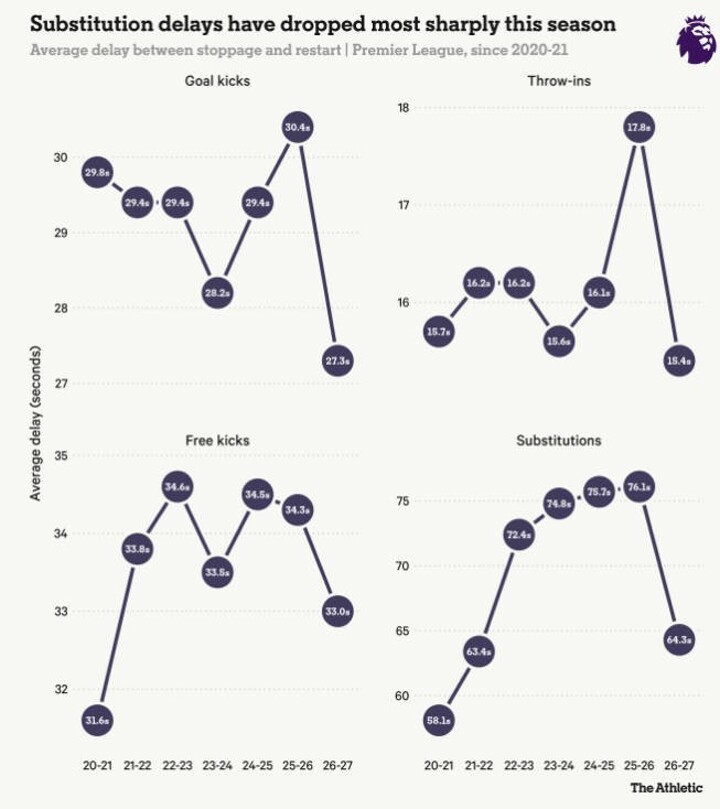
Average Substitution Time in Premier League Matches Since 2020-21
So far, the deterrent effect of penalties is mainly reflected in players exiting the field more quickly during substitutions. Only Crystal Palace has been penalized for violating the 10-second rule, when Hajrović's substitution was too slow in their 1-4 loss to Manchester City, leaving Guéhi waiting an additional minute on the sideline.
Throw-ins and goal kicks, both now timed by referees, have also shown significant reductions, reaching the lowest levels in the past seven seasons. This timing method appears to be particularly effective with throw-ins.
Last season, the average time per throw-in was 17.8 seconds, an increase of 1.7 seconds from the previous season. This may not seem like a major change, but throw-in times are generally quite stable, with variations typically around 16 seconds.
Considering there are approximately 17.5 throw-ins per match on average, this 1.7-second increase equates to roughly 30 seconds of additional stoppage time per match. However, this season the trend has reversed, with average throw-in time dropping to 15.4 seconds.
Last season's increase was closely linked to a significant rise in long throw-ins, with the proportion of long throw-ins attempted in the attacking third jumping from 13% in the 2023-24 season to 31% last season.
These carefully constructed sequences inevitably take time. Center-backs need to push into the box, and the throw-in taker requires a longer run-up to deliver the ball into a congested area. Under the new rules, the countdown begins once players are in position, so long throw-ins are still permitted.
Because of this leeway, the teams best at long throw-ins still maintain the longest throw-in delays, with Brentford leading the way, known for their long throw-ins associated with Kayode.
However, the biggest reduction came from Tottenham. Since long throw-in specialist Kevin Dunk transferred to Sunderland, Tottenham has largely abandoned long throw-ins, reducing their throw-in time by approximately 8 seconds.
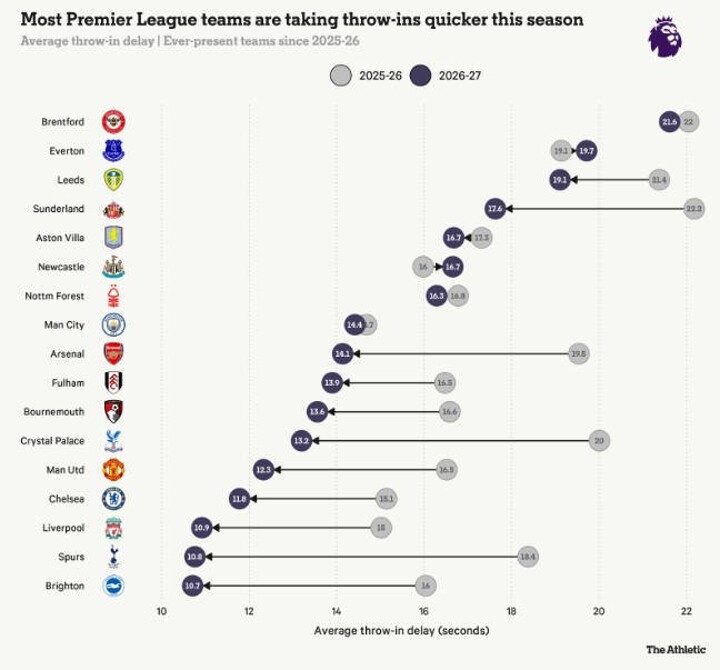
Average Throw-in Time for Each Premier League Team Over the Past Two Seasons
The situation is similar with goal kicks, with all but three teams kicking off faster than last season. This measure, aimed at addressing time-wasting, has ultimately allowed fans to enjoy more exciting matches.
Effective playing time has reached 57.8%, slightly exceeding last season's 55.1%. Of course, it is premature to draw conclusions, and continued enforcement throughout the season will be necessary to sustain this improvement.
There are still some areas where time can be saved during matches, including attacking free kicks and corner kicks. While referees initially enforce rule changes strictly, they often tend to downplay their importance quietly as the season progresses—a pattern not without precedent.
The 2016-17 season is a typical example, when the Premier League paid particular attention to shirt-pulling during corner kicks. In Matchweek 2, Manchester City beat Stoke City 4-1, and referee Mike Dean awarded two penalties for players pulling each other's shirts during set plays.
However, as controversy grew, this strict refereeing approach quickly disappeared. The time saved through faster substitutions and set plays was later offset by prolonged VAR reviews and incorrect decisions, such as those in Manchester derbies.
Nevertheless, for now the overall impact is positive. If this meticulous timing is maintained throughout the season, it would be a long-awaited victory for Premier League referees eager to improve the game.
AI翻訳。
AFのPCサイトが新登場!パソコンでニュース、コメント、試合詳細、詳細データをご覧いただけます。アクセス:www.allfootballapp.com
 アーセナル
アーセナル
 チェルシー
チェルシー
 マンチェスター・ユナイテッド
 リヴァプール
 ニューカッスル・ユナイテッド
 アストン・ヴィラ
 フラム
フラム
 エヴァートン
 トッテナム
トッテナム
 マンチェスター・シティ
 クリスタル・パレス
 リーズ・ユナイテッド
 サンダーランド
 イプスウィッチ・タウン
 コベントリー
 ノッティンガム・フォレスト
 ブライトン&ホーヴ・アルビオン
 ボーンマス
ボーンマス
 ブレントフォード
 ハル・シティ
すべてのコメント