
Ahead of Germany's away match against Greece in UEFA Nations League A matchday 4, Germany national team manager Jürgen Klopp attended a press conference and answered questions from the media. The first half of the press conference is as follows.
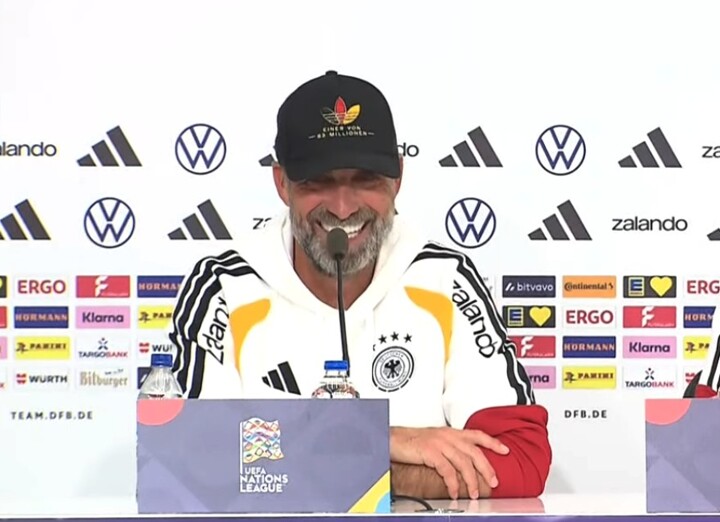
Spokesperson: Today we have Jürgen Klopp, manager of the German national team, and player Pavlović at the press conference for tomorrow's Greece vs. Germany match. We want to thank Germany sincerely for the warm hospitality. However, Jürgen, I think tomorrow on the pitch things won't be quite so friendly. But for you, this is also a chance for revenge. How do you plan to seize this opportunity?
Klopp: Warm hospitality? Should I answer in German or English?
Spokesperson: German is fine. It will be translated into Greek locally.
Klopp: That's a great idea. What was the question again? Oh yes, first of all, I'm really happy to be here. I've never played here before. I thought I'd played almost everywhere, but this is my first time. Yes, tomorrow we want to certainly perform much better than we did in the first match. We tried many things in that first match—some things worked, but it wasn't enough to beat Greece. Greece played with extreme tactical discipline and deserved their victory. We have to acknowledge that. After that, we played Serbia, and our performance in that match was significantly better. If we can maintain that level tomorrow and show something even better, we'll be a much tougher opponent for Greece. That should be a good start.
Reporter: Coach Klopp, you usually don't reveal your starting XI, but you're always clear about goalkeeper rotation. Will you rotate goalkeepers tomorrow? Will we see a fourth goalkeeper play? Also, I'd like to ask about Renato Sanches. You adjusted the squad list and he joined the team in week two. Was that because previously he hadn't fully recovered from injury?
Klopp: About goalkeeper rotation—have I always talked about that? How did that become a habit? Right now, it doesn't look like we'll rotate goalkeepers tomorrow. But who knows...
Regarding Renato Sanches, it's similar to Serge Gnabry's situation, just in the opposite direction. Renato was originally scheduled to join in week one, but Bayern Munich's medical department got in touch and said he needed time to catch up in certain areas and preferred to do individual training at the club for a longer period. I said, "Okay, let's do that." Our national team also aims to help players as much as possible, and ideally help the clubs too. So he joined in week two, and Karim joined in week one.
As for Serge, he participated in all training sessions and played exactly as planned. After playing 45 minutes in the third match, he had no injury at halftime but was feeling some fatigue. So we substituted him and made it clear there was no need to take the risk. He'll return to Bayern with three matches of playing time and in excellent training condition. That's ideal player management. He could have stayed, but I thought it would be better for him to have another two or three days of rest before resuming normal training in Munich.
Reporter: On Thursday, you said you weren't sure whether Greece would set up defensively like they did in the first match or come out a bit more offensively. After watching the Greece vs. Netherlands match, what conclusions did you reach?
Klopp: In football, you can never be completely certain. It's more of a strong hunch than foresight. Their possession against the Netherlands wasn't quite as high as ours against Serbia, but it was close. Greece led 2-0 and created some great chances. Of course, the Netherlands had chances in the first half too, but they didn't play at a very high tempo early on, and after stepping up the pace in the second half, they created big problems for Greece. These are helpful clues, but essentially nothing more than that.
We're prepared for both scenarios. Tonight, the players will watch analysis footage we consider important. But before that, our training has been completely focused on the tactical content we want to execute. Tonight, we'll integrate all the details, and tomorrow we'll execute it on the pitch. But ultimately, it also depends on our own performance. If we play well, Greece will have no choice but to sit deep. We've already experienced their defensive solidity at Augsburg.
Greek Reporter: Hello, welcome to Greece, Thessaloniki. I'd like to ask Coach Klopp—if you imagine yourself at a Premier League or Champions League press conference, if possible please answer in English. After the first match, what new insights did you gain about this Greek team? Were you somewhat relieved to learn that Tsimikas will miss this match?
Klopp: I don't think I learned anything new about this Greek team from the first match, because I already knew about their quality. From my perspective, I can't know every Greek team from the past 10 or 20 years, but this might be Greece's golden generation. If excellent players come together and execute their tactics faithfully, they become extremely difficult for any opponent to face—as we saw with their deep defense and resolute counter-attacking in Augsburg. And that night was certainly a tough match for us too. But I didn't realize that from that match; I knew it from the start.
Yes, I heard the news that Tsimikas can't play. It's unfortunate for him personally, for the Greek team, and for his club. But I don't dwell on such things. What matters isn't who plays, but how we play as a team. I hope he recovers quickly and comes back in a week, two weeks, three weeks. That would be good for him. Other than that, we don't know their lineup tomorrow. Just as you don't know ours. It's a fair match, but I'm confident Greece will still put out a strong team tomorrow.
Reporter: Hello, Coach, welcome to Greece. It's been a long time since you stepped away from the bench. Do you miss being on the pitch every day with your players? Are you thrilled to be back at the forefront?
Klopp: To be honest, I didn't miss anything. But I discovered that I still enjoy what I'm doing. So no, I didn't miss it. I must be quite a rational person. When I'm not doing something, I don't miss it, but once I do it again, I realize how much I enjoyed it. That's exactly how it is. I was very busy while not coaching, but now I'm here. Working with players like these is a blessing. To be honest, seeing them perform on the training pitch is pure joy, and I feel incredibly fortunate to be able to see this team up close as their manager. We're still just getting started. This is our fourth match in two weeks, so the pace is certainly fast, but I haven't been nostalgic about the past. We're looking forward to a shared future.
Reporter: Hello, Coach, welcome. I have one question. Kostas Tsimikas previously said he would use what he learned from you to beat you. First, did you speak to him about this? Were you aware of it? And do you think that's true? Thank you.
Klopp: What? He learned from me, or I learned from him?
Reporter: He said he would use what he learned from you to beat you in this match—to beat you with your own weapons.
Klopp: Ah! Haha, Kostas is quite the joker, isn't he? Yes. If he really said that, I can respond: "I didn't..." No, I better not say that. Okay, let's see what he actually learned. I don't know either. I'm happy to see him again today; he's a great guy. It's always like meeting an old friend when you see players you've coached before, and this time is the same. To be honest, when we met, we didn't talk about football at all. So tomorrow, let's see what he really learned from me—or hopefully, nothing at all. (Laughs)
AI翻訳。
AFのPCサイトが新登場!パソコンでニュース、コメント、試合詳細、詳細データをご覧いただけます。アクセス:www.allfootballapp.com
 アーセナル
アーセナル
 リヴァプール
 バイエルン・ミュンヘン
 ドイツ
ドイツ
 ギリシャ
ギリシャ
 ユルゲン・クロップ
 セルジュ・ニャブリ
 コスタス・ツィミカス
 クリストス・ツォリス
 ウルビヒ
ウルビヒ
 パブロビッチ
 カール
カール
すべてのコメント