
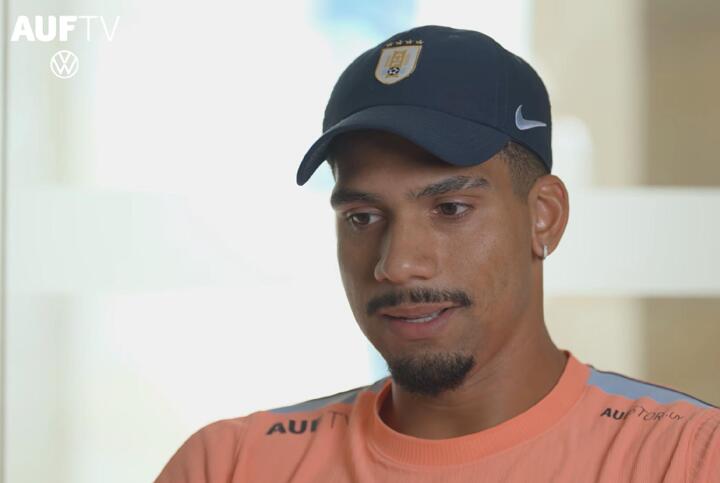
During the Uruguayan team's preparations for the friendly match against India, Araujo was interviewed by the official media of the Uruguayan Football Association. He discussed his regret about not playing in two World Cups, his adaptation to Liverpool, his experience working with new coach Forlán, his relationship with Núñez, and his family life. This article is the third part of the interview.
Other parts of the interview
R. Araujo: It's hard not to play in two World Cups; I'm very comfortable at Liverpool
R. Araujo: I'm more like Núñez's father because I have to take him everywhere
After the World Cup, there was also a change of head coach, with Diego Forlán now in charge. What has this experience been like for you? You watch a lot of football and admire many players, and Forlán is a legend. How have you adapted to the shift from viewing Forlán as an idol and legend to now having him as your head coach?
I think as you gain experience, it becomes easier to view these things more naturally. But having Diego as my head coach is still very special. He used to be an idol of the Uruguayan team, but now he's become my coach, which is truly special.
Moreover, I have a very interesting story to tell. A few days ago, I asked my mom to find a photo from the 2010 World Cup. I was still in school at the time, and she had made a composite photo of me holding Forlán. Just think—back then it was a composite photo, and now he's actually become my head coach. For those of us who grew up watching Diego play, this is truly special.
It's wonderful to have him here with us. We know what he means to our country, and he has a lot to bring to us and help us with. We've only trained together for a short time, but we can already see how deep his understanding of football is. We will try our best to apply what he tells us in matches.
In the two matches under Diego Forlán, you played as a right-sided center-back. What did he tell you? What demands did he make?
Nothing specific. He gave me complete freedom. I have to take responsibility and become one of the team's leaders, one of the leaders of the defense. I feel that I am mature enough and experienced enough to do that.
As I said earlier, I will be honest. I think I might not have done that before because of various circumstances—missing important matches, one thing after another—which somewhat held me back, right?
But now I have to let go, enjoy all of this, and be myself. I know that on the field, I can bring a lot to this team, not just on a football level, but also in terms of leadership. So I am taking on this responsibility. Diego certainly gave me confidence, and this is what I want to do from now on and in the future.
How do you evaluate these two matches? The results were different, but the performances were relatively similar. What is your assessment of the matches against Japan and South Korea, respectively?
I think what happened in both matches is very clear for everyone to see. Overall, it was very positive. There were many positive aspects in both matches, even though we lost to Japan. If you look at the entire match, you'll find that we played very well, created many scoring opportunities, and had every chance to win.
From a tactical perspective, despite only training for one day, we pressed their build-up from the back and did well tactically. We only lost control of the game in the last two minutes. This is also where these friendly matches help us learn. Overall, we played a very good match.
Against South Korea, these things became more apparent. We had more preparation time and training time, and were able to see the results of the training and the players' abilities. We have a very excellent squad with many very good players who can make great contributions.
I think in the match against South Korea, we showed the level we can reach. This match should serve as a very good reference for our future, allowing us to see what kind of team we can become.
A team with high intensity, a cohesive team, a team that acts together no matter what. Ultimately, these things were reflected in the goals and the score. South Korea is a very good team. Through our style of play, we might have made them look a bit inferior, but they are indeed very good.
This international break will conclude with the match against India. You've had more time to prepare and train, and apart from those who had to leave, most players are still here. What are your thoughts on this match? What do you hope the team will take away from Forlán's first international break as coach?
I hope that we can end this international break on a positive note. I think we've been doing well. Now, with more training time, the coach can further implement his philosophy and what he wants us to do.
Preparing for this match is a wonderful thing. We need to approach it in the best possible way, strive for a good result, and then everyone can return to their clubs in good spirits and with a good feeling. We want to leave behind something that can help us continue to grow in this phase—a good feeling for everything that comes next. I believe that the next phase will be a very good one for us and for our country.
Finally, I want to ask you about your role as a father. You just mentioned this when talking about Darwin, but this time it's about being the father of Aitana and Adara. They are growing up and starting to understand who their father is. How do you balance these different identities: being a father, a role model, a football star, and an ordinary person?
They are still very young and innocent. However, Aitana understands more; she has started to realize that I am a football player. Adara is still very small. I try to separate work life from home life. Over the years, I have learned to do this.
Before, I might have brought work emotions and issues home, and that didn't feel good. So now I have learned to deal with this and separate the two. At home, I am a father and a husband, and we enjoy our time together. Because they are still so young, the most important thing is to enjoy the time spent with them.
You remind me of a very interesting story that also reflects the innocence of children. Once, when you took your eldest daughter to school, what happened? What did she say about the shoes—or rather, the slippers you were wearing?
That story is truly special, right? That day I took her to school wearing a pair of slippers that were quite bright in color. I thought they were fine, but when we got to school, she started telling me, "Dad, I feel embarrassed."
I asked, "Embarrassed about what, Aitana?"
She said, "Because you're wearing those slippers."
I said, "Aitana, but I like these slippers."
She said, "No, but I feel embarrassed."
Just imagine—a four-year-old would say these things to you. I found it very funny, but it also makes you realize that they are slowly growing up. She was already feeling embarrassed because I was wearing those shoes. But it was a beautiful moment, truly very interesting.
Thank you, Ronald. I hope a beautiful phase begins now and that good things start to come one after another. You deserve these, and the Uruguayan team does too.
Alright, thank you very much. Keep working hard. I believe that good times will definitely come.
AF's PC site is now live! Browse full news, comments, match details and stats on your computer. Visit: www.allfootballapp.com
 リヴァプール
 ウルグアイ
ウルグアイ
 Diego Forlán
 アラウホ
アラウホ
すべてのコメント