
According to AS, Spanish football is seeing the re-emergence of a new generation of center-forwards whose primary operating zone is the penalty area. Young strikers under 25 such as Gonzalo, Espi, Guiu, Samu, and Roberto are reviving the "number 9" role, which was once thought to be on the verge of extinction.

There was a time when the penalty area seemed an uncomfortable zone for Spanish football. For years, Spain learned to survive without a classic center-forward. The national team found goals through players who were agile, good at link-up play, and could freely interchange positions in attack. They even won the European Championship with Cesc Fàbregas playing as a false nine. All of that now feels like it belongs to another era. Spanish football has begun to cultivate strikers who look at the goal first, then at the ball. They don't need to drift away from the box to be involved in the game. Gonzalo, Espi, Guiu, Samu, and Roberto, all under 25, are restoring a role that for years seemed almost extinct: the clinical number 9.
To understand why their return is surprising, one must look back. Fernando Morientes was one of the last Spanish center-forwards who was instantly recognizable. Tall, strong, excellent in the air, and possessing a special instinct for where the ball would land. The penalty area was his domain. Morientes once told AS: "Playing wide is for other types of players. I've always championed the pure center-forward, the traditional number 9. Teams must have such players. They offer you many options."
After him, the national team saw Fernando Torres, whose greatest strength was attacking space, and David Villa, who could play as a number 9 but also started from the left wing and participated in link-up play away from the box. Spain began to develop forwards who understood attacking as a constant exercise in movement. The more movement there was, the less necessary a number 9 seemed.
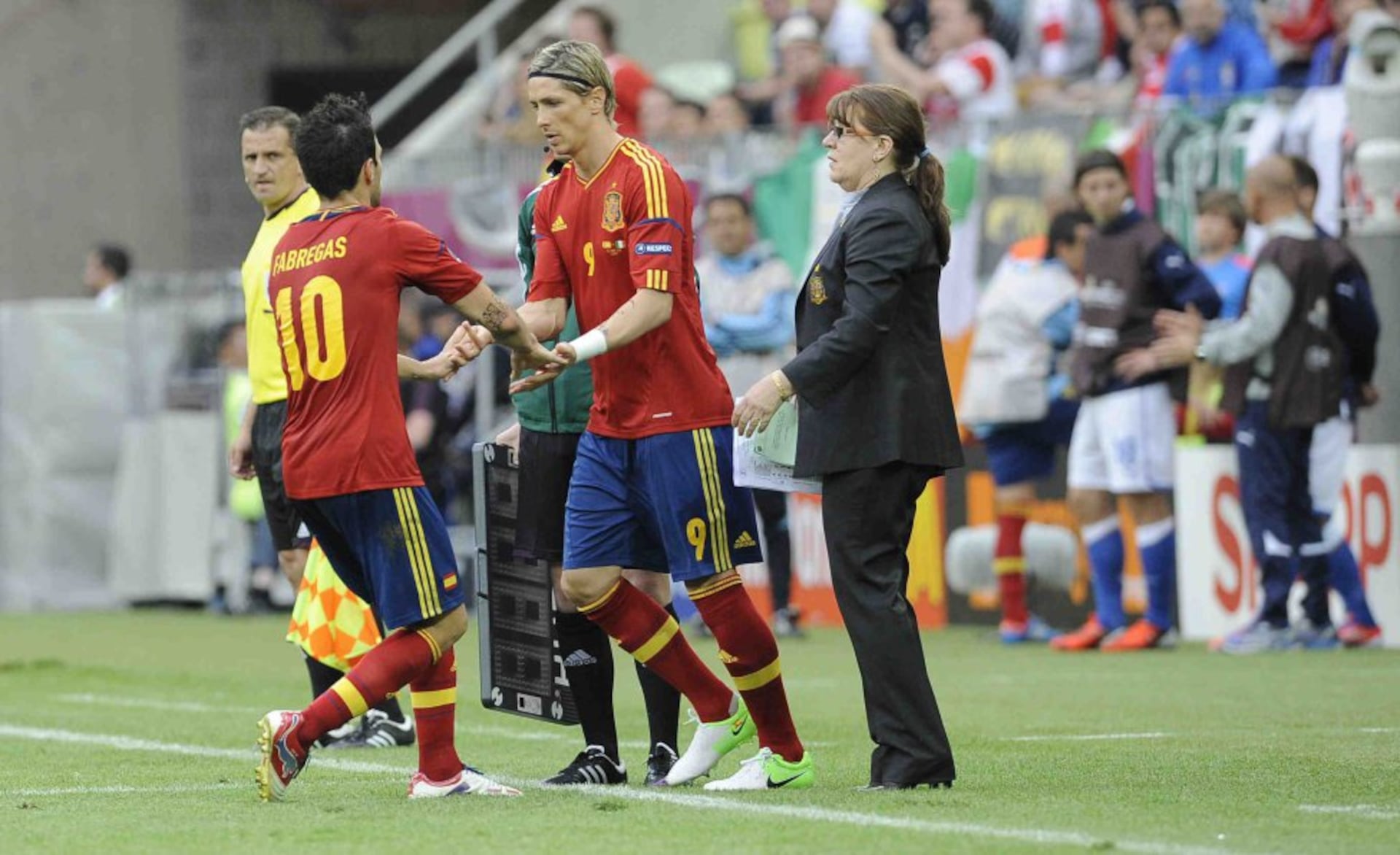
The day Spain abandoned the number 9
The 2012 European Championship might be the most extreme example of that evolution. Spain had Fernando Torres, Negredo, and Llorente. Yet Del Bosque found a solution that perfectly suited the team's style of play: dropping the centre-forward and playing Cesc as a false nine.
The "small guys" won that battle. The centre-forward didn't disappear from the national team but was no longer indispensable. A paradox emerged. Spain was still producing number 9s, but many struggled to find their place. Negredo, Llorente, and later Diego Costa all had strong cases to occupy that position, but none became a stable benchmark. Becoming Spain's number 9 became an especially difficult task because the system required the striker to adapt to a team that rarely used him as an attacking reference. The result was a rotation of players with different names and characteristics, searching for a position that seemed increasingly unnecessary.
This philosophy had a profound impact. In subsequent years, Spain continued to trust attackers who could do many things rather than just one. Rodrygo, Adrien, Morata, Oyarzabal, and Ferran Torres, with their different attributes, represented this evolution.
Strikers who move out of the box
Oyarzabal and Ferran are two of the most representative examples from the recent past. They are goal-scoring forwards, but not classic penalty-box strikers. They need freedom; they can play centrally, start from the wing, or interchange positions. Their value lies not only in finishing but also in everything that happens before.
Spain found solutions in them, and also when Merino occasionally played as a false nine. Thus, the national team reached the point of winning its second World Cup that summer without relying on a pure centre-forward.
But football has a peculiar way of circling back. Now, players are emerging from grassroots football, seemingly suggesting that the position may not have died. It was just waiting.
The new number 9s
There is something recognizable in the way Gonzalo, Espi, Samu, Roberto, and Guiu understand the game. They are forwards who want to be near the goal. They don't need constant involvement in passing to feel part of the game.
Each does this with different nuances. Gonzalo and Espi have a clear finishing tendency; Guiu and Roberto—the latter receiving his first national team call-up after scoring six goals early in the season—provide a physical presence; Samu perhaps represents the clearest example of the power this generation of players can offer, with his long strides, deep runs, and ability to dominate centre-backs. They belong to different eras of players, but there is something timeless in their footballing language: finishing.
Regarding Roberto's inclusion in the latest squad, de la Fuente said: "We have been following Roberto closely, and his moment has arrived. He is doing very well, has already scored six goals, and perfectly fits the type of alternative striker we are looking for." Clearly, Spain will not abandon players who can drift wide, participate in build-up play, or interchange positions. Oyarzabal and Ferran will still be valuable options. The difference is that now there is another alternative.
For years, one of the first questions asked about a Spanish number 9 was how much he could contribute outside the penalty area. Now, another question has become important again: how much damage he can cause when he decides to stay in the penalty area.
From Morientes, who dominated the box, to Fernando Torres, who attacked space. From Villa, who could start from the wing, to Cesc's false nine. From Negredo, Llorente, and Diego Costa—who never became stable benchmarks in the national team—to Morata, Oyarzabal, and Ferran. And from there to Gonzalo, Espi, Roberto, Samu, and Guiu. Perhaps the number 9 never truly disappeared.
AF's PC site is now live! Browse full news, comments, match details and stats on your computer. Visit: www.allfootballapp.com
 ဖူလ်ဟမ်
 ရီးယဲလ် မက်ဒရစ်
 အက်တလက်တီကို မာဒရစ် B
 စပိန်
စပိန်
 အာဘီ လိုက်ပ်ဇစ်
 Fernando Torres
 Fernando Morientes
 ဂွန်ဇာလို ဂါစီယာ
 ဂီယူ
ဂီယူ
 ကားလိုစ် အက်စ်ပီ
မှတ်ချက် အားလုံး (2)
ဒီနေ့ 22:59
ဒီနေ့ 21:17