
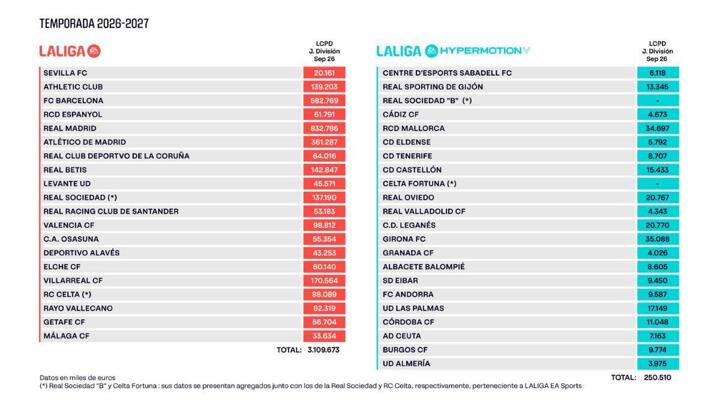
According to Sport, La Liga has set Barcelona's squad cost limit (LCPD) at 582.759 million euros, but this is not the same as the funds available to the club for transfers.

Like every year, September marks a turning point in the season—not just in football, but also financially. After the transfer window closes, clubs learn the results of their planning, and La Liga announces squad cost limits after the registration period ends.
Barcelona, like other La Liga and Segunda División clubs, receives figures that determine its financial limits for registering players.
However, it's important to clarify a common misconception: LCPD (Límite de Coste de Plantilla Disponible, or Available Squad Cost Limit) is not "money available for transfers," but rather the maximum limit determining how much a club can spend on registering new players or contract extensions, including existing players and coaching staff.
To understand why La Liga set Barcelona's limit at 582.759 million euros, one must explain how this calculation works.
A Continuous Process Beginning in April
Clubs' financial seasons typically begin earlier than most people realize.
If we are currently in season T, clubs are already budgeting for the next season. The regular deadline for submitting the T+1 season budget, explanatory reports, additional information, and statements of responsibility to La Liga is April 30.
Therefore, on April 30, 2024, clubs will submit their budgets for the 2024/25 season.
These documents don't just state projected revenue and expenses. Budgets also include profit and loss statements, balance sheets, investments and divestments, financing and cash flow, and all additional information required. La Liga requires that the assumptions used must be reasonable; if certain data is deemed insufficiently substantiated or inconsistent with the club's financial reality, La Liga can adjust the figures at its discretion. For example, a newly promoted team bases its budget on qualifying for the Champions League next season.
This matters because the budget submitted by Barcelona is not necessarily the budget La Liga will ultimately use to calculate its limit.
Final Approval in June
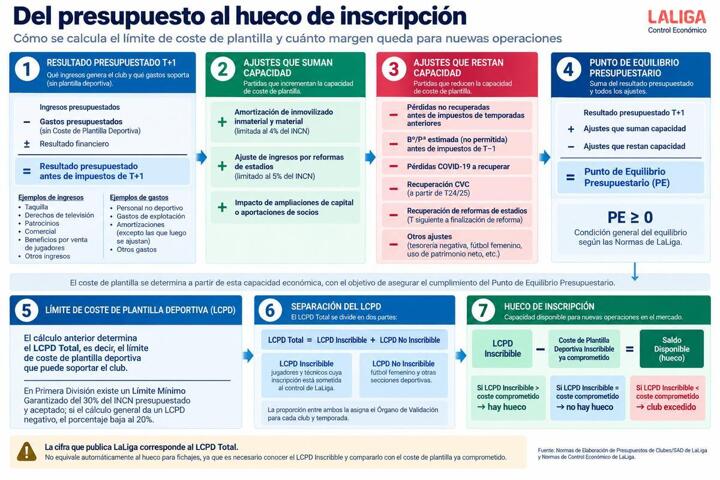
After the T+1 budget is submitted, La Liga reviews the club's financial projections and, following adjustments and verification, determines the break-even point.
The question is not just how much money the club has to pay salaries, but what operating result the next season's budget will generate, and how much squad costs the team can sustain from those results.
La Liga must assess how much revenue the club can generate and how much non-sports expenditure it must cover. Revenue includes ticket sales, broadcasting rights, sponsorships, and proceeds from player sales; this revenue must be compared against the club's other structural expenses.
Club Revenue
However, La Liga doesn't stop at this result. La Liga also adds or deducts certain items from this figure, increasing or decreasing the team's ability to spend according to the rules.
For Barcelona, stadium adjustments are crucial because the "Espai Barça" project during Camp Nou's renovation and the limited stadium operations will cause temporary revenue losses. Relevant regulations allow these revenue losses to be included to increase the LCPD.
La Liga's own explanation summarizes this mechanism: revenue losses from stadium renovations can be added to the LCPD in an equivalent amount, but limited to 5% of Net Operating Revenue (INCN).
La Liga believes that clubs improving their infrastructure shouldn't be penalized. Therefore, when calculating the break-even point and LCPD, positive adjustments can be included to compensate clubs for revenue losses from renovations; additionally, depreciation on certain infrastructure investments is excluded from the LCPD.
From Break-Even to Available Squad Cost Limit
However, an important distinction exists here. Total LCPD is not the same as all funds available for the first team. The LCPD is divided into two parts:
The next step is comparing this to existing squad costs (CPD). The Available Squad Cost Limit minus the Available Registrable Squad Costs equals the available balance.
What's Included in Squad Costs?
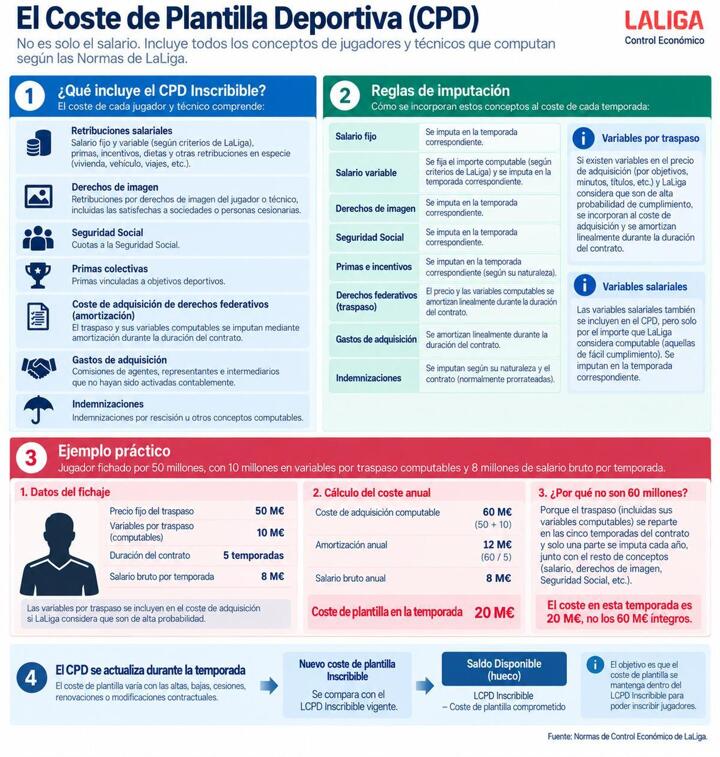
This is key to understanding what these costs truly mean. Registrable CPD is not just salaries. Relevant rules state it comprises various costs related to players and coaches, such as image rights payments, social security, and collective bonuses.
Regarding transfers, one item is particularly important: the cost of acquiring registration rights for the league. Transfer fees are typically not fully recorded in a single season but are amortized according to applicable rules. Additionally, certain acquisition costs can be included, such as commissions for agents, representatives, and intermediaries, provided these costs are not capitalized in the accounting.
For example, if a player is valued at 50 million euros, signs a 5-year contract, has an additional 10 million euros in achievable variable clauses (as La Liga considers these easily triggered), and earns 8 million euros annually before tax, their squad cost for that season is 20 million euros (12 million amortization plus 8 million salary), not the full 60 million euro transfer fee.
Finally, this calculation is not static throughout the year. At the end of November, after the previous season's financial statements are audited, La Liga can check whether there are differences between actual results and data used to calculate the limit via the budget. If deviations are significant, both the LCPD and break-even point can be adjusted. Then, in March, interim financial statements update the club's economic situation again.
Therefore, when we talk about what's called "room" or "space," it shouldn't be understood as a static figure that appears only once a year. It's an available balance that can expand, shrink, or even disappear with club operations and La Liga reviews.
Overall, Barcelona appears to be moving toward gradual financial recovery, with its new LCPD reaching 582.759 million euros. In previous seasons, Barcelona has exceeded limits and been constrained by economic control regulations.
Revenue recovery, combined with good sporting results, should give Barcelona more flexibility in the transfer market, but don't forget the significant financial cost of debt, which directly affects available squad space.
The next step is to see whether the new "Espai Barça" project can truly materialize. Its commercial development and hospitality business are expected to significantly increase the club's recurring revenue and ultimately deliver profits.
Diterjemahkan oleh AI.
Situs web AF kini hadir! Lihat berita lengkap, komentar, detail pertandingan, dan statistik di komputer Anda. Kunjungi: www.allfootballapp.com
 ဘာစီလိုနာ
မှတ်ချက် အားလုံး