
Ahead of the UEFA Nations League A matchday 4 clash between the Netherlands and Serbia, Dutch defender Dumfries attended a press conference to answer media questions.
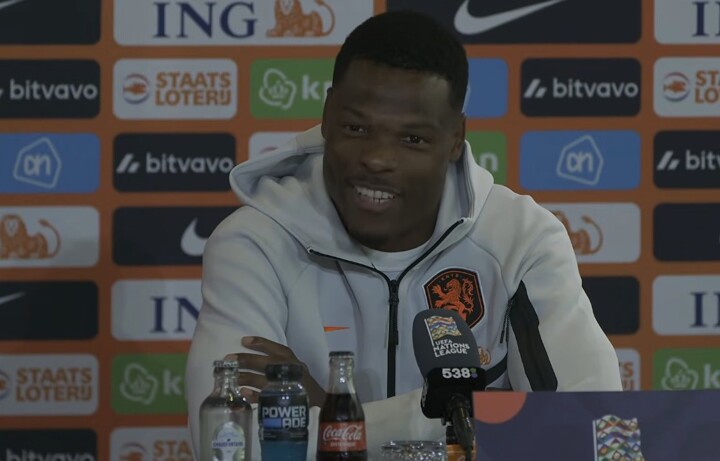
Reporter: Denzel, this will be your fourth match in two weeks. How is your physical condition?
Dumfries: I'm feeling good. Between matches, the focus is naturally on physical recovery. Of course, at the club, we are already used to such a packed schedule. So, there will definitely be some fatigue, but as the coach just said, we have to respect the schedule and give our best in every game.
Reporter: Did you get a bruised toe?
Dumfries: No, no bruising.
Reporter: I saw someone accidentally step on your foot this morning.
Dumfries: Ah, Teun (Koopmeiners) stepped on it, right? No, luckily, no bruise. Small accidents like that are unavoidable in training.
Reporter: Good that it didn't affect you. Can you really play four games in two weeks? Seeing this new competition format, are you excited, or...?
Dumfries: No, I can definitely play four games. But I do feel the workload is too heavy. I personally don't support scheduling such a long international break during the season, because it takes you away from your club for quite a long time. I personally prefer the previous format. However, having said that, since the schedule has been set, we must abide by it, but I do prefer shorter international breaks.
Reporter: One more thing. I think Virgil (Van Dijk) will play tomorrow night, which will be his 100th international cap. Did you get him a gift?
Dumfries: Now that you mention it, I actually didn't get him a gift. But the Dutch FA should give him a very nice commemorative gift. It's undoubtedly a great milestone for him, and he is a role model for the entire team. I'm very happy for him to reach his 100th cap milestone.
Reporter: Seeing this, do you think to yourself: wow, I want to achieve that too?
Dumfries: Of course, definitely.
Reporter: Denzel, what qualities about Virgil (Van Dijk) are perhaps not so easily observed by outsiders, but best represent him?
Dumfries: I think it's his consistency and focus. Giving his all every day, holding nothing back, is truly admirable. He is 100% committed every day in his words and actions, setting a very high standard for the entire team and for young players. He is absolutely an example for everyone, showing you how to approach professional football – not just being focused a few days a week, but the persistence day in and day out. It's truly remarkable.
Reporter: You've played 79 matches for the national team now, many of them alongside him. How important is he to you personally?
Dumfries: Of course, very important. He was captain when I first joined the national team, and eight years later, he is still captain, which proves the incredible consistency I just mentioned. It's great to have played so many games and competed in major tournaments with him, and a deep friendship has naturally developed between us. It's truly wonderful to have shared this journey together.
Reporter: There was an interesting anecdote after the match against Greece: you very politely and respectfully told a Greek reporter: "Sir, please show some respect, we are in the middle of an interview." Did your teammates tease you about it, about how direct you are?
Dumfries: The lads in the team did indeed joke about it. But you were also there. That reporter was indeed too noisy, everyone had already asked him twice to quiet down, but he didn't listen at all. At that moment, I thought, okay, I'll talk to him. Fortunately, he accepted it, and the interview continued. But my teammates found that moment quite amusing.
Reporter: Your expression at the time was quite classic too.
Dumfries: It was a pure instinctive reaction. I'm not sure what my expression was, but at that moment I felt I had to step in and stop it.
Reporter: Denzel, we just talked about honestly facing problems, and the coach also mentioned maintaining consistency. You have a lot of experience in the team; for you all, what is the key to maintaining a high level throughout both halves? Because in previous matches, this was clearly a difficult task.
Dumfries: Yes, this is indeed a problem we have been facing. I think in the first half, to look for reasons within ourselves, our game tempo must be faster. At the same time, I feel that we sometimes lack the penetration into deep spaces. When you get the ball behind the defensive line, you can break down the opponent's defensive shape and force them to react. But in that regard, we seem too passive, and our passing speed is too slow.
I think this is a lesson we must learn in upcoming matches. When the opponent drops deep and defends compactly, the game is obviously difficult, but I think it is precisely at such moments that we need to speed up the wide distribution of the ball, even with cross-field passes. We also summarized this – don't always stick to finding the nearest passing option, but decisively switch to the flanks to find one-on-one breakthrough opportunities. I feel that in the early stages we did far from enough in this regard, and thus failed to put enough defensive pressure on the opponent.
Reporter: Why do you struggle so much when the opponent, as the coach mentioned, plays long balls directly to the striker, followed by winning second balls, and full-backs pushing high? You always seem to struggle when the opponent pushes up with all their lines.
Dumfries: This is because we are tactically inclined to attack proactively, committing a lot of players ahead of the ball. Once the opponent wins the second ball, they launch a counterattack at full speed, and it is extremely challenging to always maintain a perfect defensive position at such moments. And I think we are not the only ones encountering this problem; I often face similar situations in club matches. We are constantly trying to perfect our defensive cover during transitions from attack to defense, but sometimes in football, when the opponent wins the second ball and is in a favorable position, it can be very tricky to defend.
Reporter: I'm mainly referring to the first half, when the team was 0-1 or even 0-2 down. Was the internal communication on the field not effective?
Dumfries: It wasn't completely ineffective, but at that moment, we couldn't immediately turn the passive situation around. But a game has 90 minutes, and it proved that we ultimately had the ability to turn the game around.
Reporter: Good afternoon. The Netherlands has not kept a clean sheet in 11 matches this year. Is this becoming a troubling issue? After all, besides Germany, the other opponents are not considered world-class teams. Is defensive conceding a key point of discussion internally?
Dumfries: Of course. While it's not a major crisis, it's definitely an important topic. Looking at our defensive lineup, we shouldn't be conceding so many goals. This is an area we must work hard to improve and a challenge we must overcome.
Reporter: Can you specifically analyze the reasons for conceding goals?
Dumfries: It's hard to generalize, as the situation is different in every match. We concede goals in different ways in each game, and I don't have specific data in my head. But in any case, reducing goals conceded is our current core task; we need to improve our defensive stability and focus.
Reporter: You will face Tadic tomorrow night. Five years ago, when you played against him in the Dutch league, there was an intense conflict on the field, which also caused quite a stir after the match. Meeting again after five years, do you still talk about it privately? Has it been resolved, or has everyone moved on?
Dumfries: No, life always moves forward. That was five years ago. In fact, after that match, we already cleared the air. When we met away in Serbia, we also shook hands. For him, it's obviously more important to catch up with his former teammates from Ajax; everyone's mind isn't on that old dispute at all.
Reporter: In his 100 international caps, what is your most memorable moment with Virgil (Van Dijk)?
Dumfries: The most memorable moment with Virgil... Phew, there are so many moments we've shared. If I had to think of one right now, it might be the penalty against Greece away, which was a tough game; and the home match against Norway, where we secured qualification. If I absolutely had to choose, I would say those key moments.
Reporter: Were there any moments when the whole team supported and stood by Virgil? Because he usually stands in front of you as a leader... Were there times when the whole team stood behind him? When exactly was that?
Dumfries: Of course, I think that was when he suffered his serious injury. He had a serious knee injury, which was undoubtedly an extremely difficult period, and he missed a major tournament because of it. During that time, the whole team consistently supported him. Besides that, he didn't have many low points where he needed such support, so it's more about the deep and close friendship between us, where everyone works together through thick and thin.
Reporter: Denzel, you just explained the situation in the away match against Serbia, especially what went wrong in the first half. The coach corrected it at halftime. But during those 45 minutes of the first half, to what extent did you and captain Virgil Van Dijk try to correct the chaos on the field by shouting and directing teammates?
Dumfries: We were certainly constantly trying to communicate. Everyone was always reminding each other, trying to pick up the pace of the game through shouting and physical challenges. Although I lost a challenge on the first goal conceded, we were always trying to boost the team's morale, responding appropriately on the field, showing determination to push forward and press high through body language, asking everyone to speed up. Of course, at halftime, when everyone sits down and looks each other in the eye, that's the best time to thoroughly sort out tactics and unify ideas. But during the game, we did try to adjust, it's just that the effect in the first half was not ideal.
Reporter: When everyone on the field communicates constantly but with little effect, doesn't the situation become increasingly difficult and tricky?
Dumfries: I don't think it's an insoluble problem. As we saw from our performance in the second half, communication ultimately had a significant effect. Of course, the coach made tactical adjustments, but the players also had an open and in-depth discussion at halftime, and everything was said very clearly. So I don't think this is a structural problem, and it proves that we are capable of turning the situation around.
Reporter: I'm mainly referring to the first half, when you went from being one goal down to two goals down... Immediate communication on the field seemed completely ineffective?
Dumfries: It wasn't completely useless, it's just that at that specific stage we couldn't immediately turn the tide. But a game has a full 90 minutes, and the key is that we ultimately managed to turn the situation around.
AF's PC site is now live! Browse full news, comments, match details and stats on your computer. Visit: www.allfootballapp.com
 လီဗာပူး
 နိုင်မေဂျင်း
 နယ်သာလန်
 ရီးယဲလ် မက်ဒရစ်
 ဆားဘီးယား
 Xavi
Xavi
 Dusan Tadic
 ဒမ်ဖရိုင်းစ်
 ဗာဂျီလ် ဗန်ဒိုက်
မှတ်ချက် အားလုံး