
Ahead of the UEFA Nations League A matchday 4 clash between Germany and Greece, German national team head coach Jürgen Klopp attended a press conference to answer questions from the media. Below is the first part of the press conference.
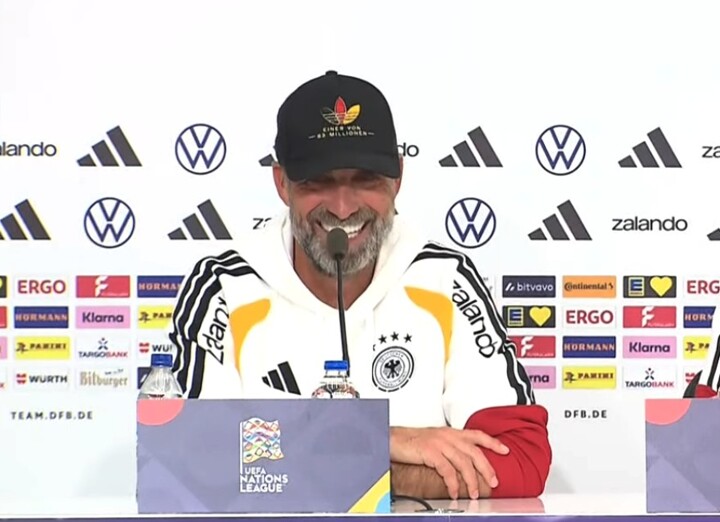
Press Officer: Attending the press conference ahead of tomorrow's match between Greece and Germany is German national team head coach Jürgen Klopp and Pavlovic. We are very grateful to our hosts for their warm hospitality. However, Jürgen, I don't think tomorrow will be quite so friendly on the pitch. But for you, this is also a chance for revenge. How are you planning to approach it?
Klopp: Warm hospitality, you say? Should I answer in German or English?
Press Officer: German is fine; we'll have interpretation into Greek on site.
Klopp: Good idea. What was the question again? Ah yes, first of all, we are delighted to be here. I have never played here before. I thought I had played just about everywhere, but not here. Yes, we certainly want to try to get a much better result tomorrow than in the first match. In the first match, we tried many things; some worked, but it wasn't enough to beat Greece. The Greeks played with outstanding tactical discipline and deserved their victory, which has to be acknowledged. After that, we faced Serbia, and our performance was considerably better. If we can continue that and show even more tomorrow, we will be a more difficult opponent for Greece, and that would be a good start.
Reporter: Mr. Klopp, you generally don't reveal your starting lineup, but regarding goalkeeper rotation, you always make clear statements. Will you rotate again tomorrow, and will we see a fourth goalkeeper on the pitch? Also, I'd like to ask about Lennart Kimmich: you adjusted the squad, and he joined in the second week. Was it because he wasn't fully fit beforehand, and what is his current condition?
Klopp: I always make statements about rotating goalkeepers? How did I develop that habit? Currently, it seems we don't have plans to rotate goalkeepers tomorrow. But who knows...
Regarding Lennart, it's actually similar to Gnabry, just different circumstances. Lennart was originally scheduled to join in the first week, but Bayern Munich's medical team called me to discuss it, saying he needed to improve in some areas and they wanted him to do more individual training at the club for a while. I said: "Okay, fine." Our national team is also there to help players whenever we can, and ideally to help their clubs as well. So he joined in the second week, while Karim joined in the first week.
As for Gnabry, he participated in all training sessions and matches as planned. After playing forty-five minutes in the third match, he didn't suffer an injury in the first half, but he felt overloaded. So we substituted him and made it clear there was no need to take risks. Now he's returning to Bayern having played in three matches and in excellent physical condition. This kind of player management is ideal. He could have stayed, but we thought it would be better for him to have an extra two or three days' rest in Munich before returning to regular training.
Reporter: On Thursday, you said you weren't sure how Greece would approach the match—whether they'd defend as deeply as in the first match or play more openly. After reviewing the Greece vs. Netherlands match footage, what conclusions have you drawn?
Klopp: In football, you're never completely certain. Instead of certainty, we have a strong intuition. In their match against the Netherlands, their ball possession wasn't as high as ours against Serbia, but it was similar. Greece led 2-0 and had excellent chances. Of course, the Netherlands also had chances in the first half; they didn't play at a very high tempo in the first half, but after accelerating in the second half, they created many difficulties for Greece. These are reference points, but essentially, that's it.
We've prepared for both scenarios: tonight, the lads will watch analysis clips that we consider very important. But before that, our training was completely focused on the tactical approach we want and should play. Tonight we'll integrate all the details and implement them on the pitch tomorrow. However, ultimately, it also depends on our own performance. If we play well, Greece will have to defend deeply as well. And regarding their deep defensive capabilities, we experienced that in Augsburg.
Greek Reporter: Hello, welcome to Greece, to Thessaloniki. I'd like to ask Mr. Klopp—if you were at a Premier League or Champions League press conference, please answer in English if possible. After your first meeting, have you gained any new insights into this Greek national team? Do you feel it's easier now knowing that Tsolis will be unavailable for this match?
Klopp: I don't think I learned anything new from the first match because we already knew about the quality of this Greek team. In my view—although I can't have followed every Greek lineup over the past one or two decades—this might be Greece's golden generation of football. When exceptional players unite and adhere strictly to their tactical discipline, like the way they defended deeply and countered decisively in Augsburg, it becomes extremely difficult for any opponent, and it was genuinely very difficult for us that night. But I didn't realize that just from that match; I already knew it beforehand.
Yes, we heard that Tsolis won't be able to play, which is unfortunate for him, the Greek national team, and his club. But I never concern myself with these things; what matters is not who plays, but how they play as a team. I hope he recovers quickly and can return in one, two, or three weeks; that would be good for him. Anyway, we don't know their starting lineup tomorrow, just as you don't know ours. It's a fair competition, but I believe Greece will take the pitch with a strong lineup tomorrow.
Reporter: Hello coach, welcome to Greece. After such a long time away from the touchline, do you miss the pitch and being with the players every day? Does it feel wonderful to be back on the front lines?
Klopp: Honestly, I don't miss anything. But I realize I still love what I do. So I really don't miss it. It seems I'm quite a rational person. When I'm not doing something, I don't miss it; but once I'm doing it, I realize how much I love it. That's all there is to it. I was really very busy in the days when I wasn't coaching, and now I'm back here. It's fortunate to work with players like these. Honestly, watching them perform on the training pitch is pure joy, and observing this team closely as a coach, I feel incredibly fortunate. We're just starting; this is only the fourth match in two weeks, a very fast pace, but I still have to say, I've never been lost in remembering the past; I'm looking forward to our shared future.
Reporter: Hello coach, welcome. I'd like to ask you something. Tsimikas once said he would use what he learned from you to beat you. First, have you discussed this with him, and are you aware of it? Also, do you think there's any truth to that? Thank you.
Klopp: What? He learned from me, or I learned from him?
Reporter: He said he would beat you in this match by using what he learned from you—basically turning your own weapons against you.
Klopp: Ah! Haha, Costas (Tsimikas) is quite the joker... Yes. Actually, if he really said that, I could respond that I... well, I won't say it. Okay, let's see what he actually learned. I don't know either. I'm very happy to see him again today; he's a very good lad. Every time I encounter players I've coached before, it's really like meeting old friends, and this time is no different. Honestly, when we see each other, we don't talk about football. So perhaps tomorrow I'll see what he really learned from me, or hopefully he didn't learn anything at all. (laughs)
Website AF đã ra mắt! Xem tin tức đầy đủ, bình luận, chi tiết trận đấu và thống kê trên máy tính. Truy cập: www.allfootballapp.com
 အာဆင်နယ်
 လီဗာပူး
 ဘိုင်ယန် မြူးနစ်
 ဂျာမနီ
 ဂရိ
ဂရိ
 Jürgen Klopp
 ဂနာဘရီ
 ဆီမီကပ်စ်
 ခရစ်စတိုစ် ဇိုလစ်
 အာဘစ်ဂ်
 ပါဗလိုဗစ်
 လဲန်နာ့တ် ကားလ်
မှတ်ချက် အားလုံး