
According to Adam Crafton, a reporter for The Athletic, the controversy surrounding Manchester City has extended beyond football, following an independent Premier League commission's decision that found the club repeatedly breached financial rules over the past decade. Manchester City's close economic and political ties with Abu Dhabi, UAE, have placed UK Prime Minister Andy Burnham in a complex position: on one hand, Manchester City's investors have brought significant capital and development opportunities to Manchester; on the other hand, the UK government must uphold the integrity of Premier League rules to prevent the perception that large-scale foreign investment can influence football regulatory decisions.
Part 2: The Athletic: UK-UAE Economic Relations Make Manchester City Case More Sensitive
Is Abu Dhabi's Investment Also a Form of Political Influence?
Davidson, who was working in Abu Dhabi when Manchester City was acquired in 2008, believes that Abu Dhabi has sharp political acumen.
They recognized that promoting development in northern England was an important political issue, regardless of which UK political party was in power.
Previously, the UK Conservative government actively promoted the "Northern Powerhouse" initiative, hoping to narrow the economic gap between northern and southern England.
Davidson told The Athletic: "Abu Dhabi was in the right position at that time to help achieve this objective."
"There's an element of soft power in it—demonstrating to Britain more broadly that Emirati investment is needed and can have a positive impact."
"Gulf states understand UK domestic political dynamics with remarkable accuracy. They found ways to go beyond the football club itself and truly become an integral part of northern England's economy."
Most observers agree that Manchester City's ownership investment has genuinely contributed to Manchester's economic growth.
Burnham has also consistently used local development achievements as a cornerstone of his political philosophy.
Over the past decade, Manchester's economy has grown at an average annual rate of 3.1%, significantly exceeding England's national average. The constant rise of high-rise buildings has earned the city the nickname "Manc-hattan," a blend of Manchester and Manhattan, New York.
In recent years, Chanel has held fashion shows in Manchester, and the Brit Awards have also relocated from London to the city.
This winter, the NBA will also hold games at the new Co-op Live indoor arena located near Manchester City's Etihad Stadium.
The venue can accommodate 23,500 spectators, and City Football Group is one of its co-owners.
Burnham's political philosophy is often referred to as "Mancunianism."
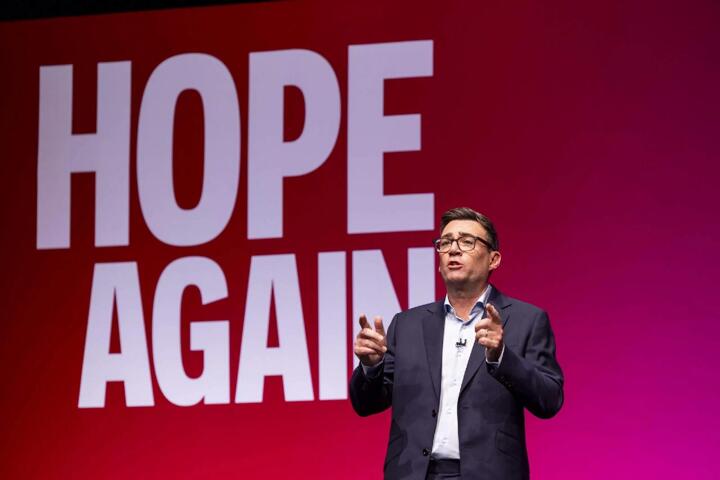
Last Tuesday, at the Labour Party conference, he stated: "I intend to take what I have done in Manchester—our plan for good growth—and spread it from the seat of government to cover every postcode area in England."
However, Manchester's development experience, once viewed as a cornerstone of Burnham's political strength, has now become a thorny issue.
If Manchester's economic growth has been driven by a football club and its owners, who have now been found to have long breached financial rules, how should this period of development history be evaluated?
If Burnham's formula for revitalizing Manchester was not simply a local initiative or policy autonomy granted by devolution, but rather excessive dependence on massive foreign capital, what scrutiny will his political philosophy face?
Although Manchester's development cannot be entirely attributed to Abu Dhabi wealth, any loyalty Burnham appears to feel toward Manchester City's ownership could raise questions about the consistency and integrity of his political stance.
Burnham Criticizes the Privileged While Embarrassed by Manchester City's Ownership
In that same Labour Party conference speech, Burnham criticized the social phenomenon where shareholders seemingly never experience losses, while ordinary people consistently fail to achieve wins.
He urged attendees to imagine a Britain "where people can once again feel that their country is behind them."
Yet now, Burnham's evident sympathy toward Manchester City's situation makes him appear to side with billionaire club owners currently facing questions over tax avoidance.
Last Thursday, Tax Policy Associates, a leading UK tax consultancy, released a report analyzing the known circumstances of the Manchester City case.
The report indicates that overseas payments made by Manchester City to then-manager Roberto Mancini alone could have resulted in approximately £12 million in lost UK tax revenue.
The firm stated in its report: "Consequences could include larger outstanding tax bills and even criminal investigation... The independent commission's finding that Manchester City deliberately submitted false financial reports implies potential violations of the Companies Act."
It is important to emphasize that this is analysis conducted by tax consultants based on available information and does not imply that related tax or criminal liabilities have been judicially confirmed.
For a Prime Minister attempting to project an anti-establishment image and emphasize alignment with ordinary British people, such a situation is clearly deeply awkward.
This also explains why Burnham quickly felt compelled to modify his previous statements.
However, these actions have still not satisfied the opposition parties.
The Liberal Democrats have called on Burnham to disclose details of all meetings he has held with Manchester City's ownership and state whether he has previously received any facilities at Etihad Stadium.
This incident also highlights a genuine dilemma facing the UK government in 2026.
After leaving the European Union, Britain is seeking investment from Gulf states. In this context, the government's attitude toward foreign capital is inevitably influenced by economic interests.
Reynolds previously told The Athletic that he does not believe he should act as a salesman for the UAE, but he nonetheless praised the UAE as a "very stable and prosperous place," whose rulers enjoy considerable legitimate recognition among the local population.
Regarding Manchester's investment development experience, Reynolds said: "It has always been a very positive thing."
If in government, officials with different political perspectives would likely express similar sentiments.
However, all these interviews took place before the Premier League announced its decision regarding Manchester City.
Only last month, Reynolds met directly with Mubarak. UK government sources deny that the Manchester City decision was discussed during that meeting.
Diterjemahkan oleh AI.
Situs web AF kini hadir! Lihat berita lengkap, komentar, detail pertandingan, dan statistik di komputer Anda. Kunjungi: www.allfootballapp.com
 မန်စီးတီး
မှတ်ချက် အားလုံး