
Argentina fans displayed multiple 'Malvinas' banners in Lionel Messi's farewell match, laying claim to the Falkland Islands.

In an emotionally charged atmosphere at 85,000-capacity Estadio Monumental, the biggest stadium in South America, some supporters took their chance to send a political message.
One banner read: 'Las Malvinas son Argentinas,' while another showed the outline of the Falkland Islands coloured in with the blue and white of the Argentina flag.
Plenty of fans brought plastic Messi masks but even though everyone was there to celebrate arguably the greatest footballer of all time, some still chose to put the controversial topic front and centre.
The contention around the banner follows Argentina's World Cup semi-final victory over England at the FIFA World Cup and fans of their rugby team holding up similar regalia during a match against South Africa in August.
After the World Cup semi-final triumph, Argentina's players used it as an opportunity to assert their claim over the Falklands, the self-governing British Overseas Territory in the South Atlantic Ocean located around 300 miles east of Argentina.

Britain has ruled the Falklands since January 1833 and in 2013 in a referendum, 99.8 per cent of citizens voted to remain as a British territory. The islands were the subject of a conflict between the two nations in 1982.
The lifting of the original banner – which also read 'Los Malvinas son Argentinas' – triggered a fierce backlash in the UK.
Former Prime Minister Keir Starmer insisted that while 'the World Cup might not be ours, the Falkland Islands definitely are. Self-determination rests with the islanders and our commitment to the Falklands will never waver.'
FIFA subsequently opened an investigation, with the governing body's rules forbidding the use of any political messaging at the World Cup.
They had, however, previously turned a blind eye to continued references to the 1982 conflict in a song sung by the players – and posted on social media by the country’s association – in the dressing room throughout the tournament.
Argentina President Javier Milei described the players' celebration with the banner as 'perfectly valid', and said the message 'reflects a sentiment shared by all Argentines'.
'I know that for Argentinians, we won the World Cup the moment we beat England because that's really what everyone wanted,' he said.
The banner at the rugby game came after the Pumas tried to mock England by wearing a kit paying homage to Diego Maradona's World Cup win in 1986, en route to which he scored the infamous 'Hand of God' goal against the Three Lions.
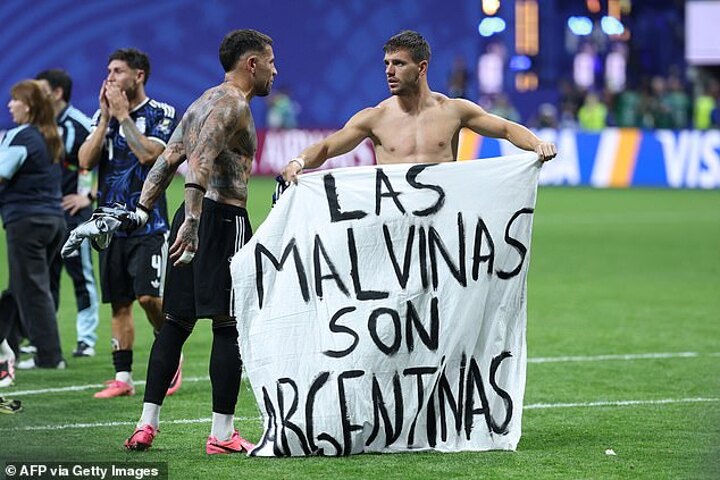


The British governance of the Falklands remains a sore point for many Argentinians and continues to rear its head during sporting clashes.
Argentina's farewell to Messi against Benin was a chance for the nation to say goodbye to their beloved football icon.
He called time on his international career after his side fell short against Spain in the World Cup final this summer.
The farewell fixture is his 208th and last appearance and tickets sold out in 90 minutes. Elsewhere in the country, a giant replica of his No10 shirt, emblazoned with the word 'Gracias' was unfurled in his home city of Rosario.
And in Patagonia, an 85ft, 70-ton statue of him kneeling with the World Cup trophy looms over motorists, with adulation for the former Barcelona superstar reaching new heights.
 လီယိုနဲလ် မက်ဆီ
 အင်တာ မိုင်ယာမီ
မှတ်ချက် အားလုံး (4)
ဒီနေ့ 08:33
ဒီနေ့ 08:25
ဒီနေ့ 08:19
ဒီနေ့ 08:13