
According to Japanese media outlet Qoly, Japan's men's football team aims to win the Asian Games championship under coach Go Oiwa with a squad of U-21 players eligible for the Los Angeles Olympics. Among these players, one of the most highly anticipated is Yuto Oseki.
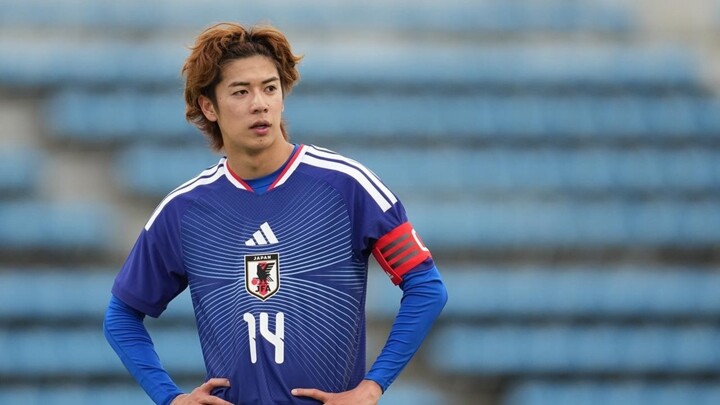
The 21-year-old currently plays for Kawasaki Frontale in the J1 League, where he is a technically skilled midfielder, also known for his striking appearance.
Recently, Yuto Oseki spoke with Kazunari Ninomiya, a TBS presenter and special ambassador for the Asian Games.
As a member of the group "ARASHI," Kazunari Ninomiya has been involved in group activities for many years and expressed surprise at how quickly the Japanese team needed to be assembled.
Ninomiya Kazunari: "For team coordination like this, is there any practice opportunity within a month after the squad is announced?"
Oseki Yuto: "There is no opportunity to practice."
Ninomiya Kazunari: "What do you do? What do you do!? It's really incredible... Do you communicate through theoretical learning?"
Oseki Yuto: "Something like that. Including the head coach, the entire team holds meetings together to gradually communicate and build chemistry."
Ninomiya Kazunari: "There are also so-called 'foreign-based players' on the team. Have you all met yet?"
Yuto Oseki: "Not yet. Even after the squad was announced, we haven't all met."
Ninomiya Kazunari: "That's amazing. Is this situation normal?"
Yuto Oseki: "Yes, it is."
Ninomiya Kazunari: "It seems I'm the only one panicking (laughs). For the players, this is actually the norm, and the older generations went through this too, so you're used to it, right?"
Yuto Oseki: "Yes, Japan's national team (senior squad) is formed the same way."
Ninomiya Kazunari: "So when exactly did you get used to this mode? Or rather, you don't really need to get used to it because you knew it was normal from the beginning, so you just do it naturally?"
Yuto Oseki: "Since we have to complete tasks under these circumstances, we simply do it; there's no other option."
Kazunari Ninomiya: "From a fan's perspective, I think through balls often require a certain tacit understanding. For example, the passer subtly senses that his teammate wants it and then delivers the pass. That's how I understand it, but isn't that actually how it works?"
Yuto Oseki: "That's right..."
Kazunari Ninomiya laughed: "So it really is like that. In that case, such a short preparation time before the match is a bit concerning."
Yuto Oseki explained: "We communicate constantly during meals and training sessions, building chemistry through frequent exchanges, and then gradually develop understanding during the match. Everyone shares how they want to play, and cooperation forms through continuous interaction and adjustment."
Kazunari Ninomiya exclaimed: "That's amazing. Is it the same for other countries' national teams?"
Yuto Oseki said: "National teams are always formed temporarily; sometimes they meet just two days before a match, which is quite normal. So I think players from other countries might also understand this."
Later, when asked who his biggest competitor was, Yuto Oseki stated clearly:
"Without a doubt, I think it's South Korea. Because we have consistently felt frustrated by South Korea at the Asian Games, I really feel that South Korea is our biggest opponent."
"Every time we play against South Korea, we can feel the fighting spirit of their players, which makes us even more determined not to lose to them."
"Of course, it's not just South Korea. When I play against other Asian teams, I also sense an attitude of 'desire to defeat Japan,' and they all put that kind of pressure on us."
South Korea is the defending champion of the Asian Games, having won four consecutive titles and aiming for a fifth. Because winning a gold medal at the Asian Games grants an exemption from military service, South Korea has fielded a squad primarily composed of U-23 players and used all three overage player spots; Japan, by contrast, is composed entirely of U-21 players and has not called up any overage players.
At the previous Asian Games, Japan was also coached by Go Oiwa and reached the final, but ultimately lost to South Korea. For Yuto Oseki, South Korea is clearly an opponent with special significance.
Since Japan and South Korea are in different groups, they won't face each other until at least the knockout stage. Japan will play its first group stage match against Hong Kong on the 16th.
Traducido por IA.
¡El sitio web de AF ya está disponible! Consulta noticias, comentarios, detalles de partidos y estadísticas en tu ordenador. Visita: www.allfootballapp.com
 Kawasaki Frontale
 Japan U21
 Yuto Ozeki
Todos os comentários