
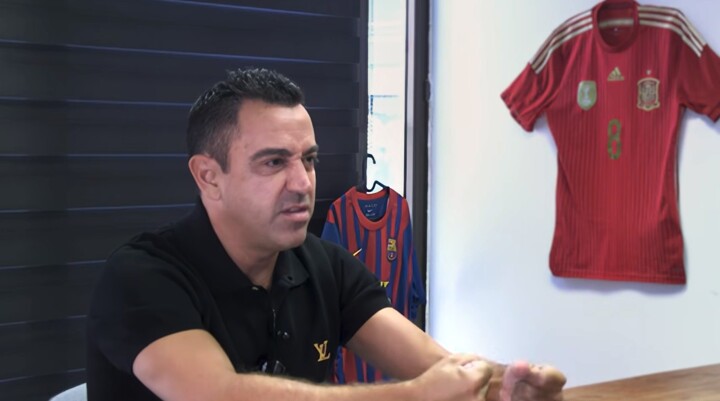
Recently, Xavi gave an in-depth interview to Indian podcast host Prakhar Gupta. In the fifth part of this exclusive interview, Xavi discussed topics including "tiki-taka not being an internal team term," position transformation, the conflict between Ibrahimovic and Guardiola, the 2009 sextuple, and the 2011 Champions League final.
That's interesting. So the term "tiki-taka" was frequently discussed in the dressing room back then? For example, emphasizing first-touch passes and quick progression to attack?
No, "tiki-taka" was more of a term created by the media. What we discussed internally was passing—controlling the ball with a single touch, passing to the supporting foot or the dominant foot. "The pass should be strong enough, go to the right foot, stop the ball cleanly, and lift your head to assess the situation." These were our fundamental principles. And "rondo"—every training session always started with a rondo, 7 versus 2, 6 versus 2. Losing possession was absolutely forbidden; whoever lost the ball went to the middle to recover it. This was our underlying philosophy.
So your role in that team was to find spaces and deliver incisive passes. You were the central figure, not a defensive midfielder, but a maestro of midfield control, maintaining possession and distributing it to the attack. Your instinct was to perceive all the spaces on the pitch.
Exactly, and also the killer pass, especially the final pass into the edge of the box. Because at the start of my career, my positioning was more defensive. But then Rijkaard enlightened me: "No, Xavi, you have the ability to play as a number 8 or even a number 10, to deliver that final pass and have a more decisive role in the attacking third." I even resisted it a bit at first. I told Rijkaard: "Frank, I'm not comfortable in that position. I prefer being deeper to oversee the entire game." He said: "No, Xavi, you need to control the game and deliver the final pass. Stop the ball, make penetrating passes, and make late runs into the box to finish." That shift to a more advanced position completely changed my life and career.
Was Ibrahimovic here before or during that period?
Zlatan was at the club for just one season, the 2009-2010 campaign. We won the Spanish Super Cup and La Liga, but we couldn't defend the Champions League title. We were eliminated by Inter Milan in the semifinals.
And then Inter beat Bayern in the final.
Yes, at the Bernabéu.
Yes, 2-0, Milito scored both goals.
You really know your football!
Very professional. (Laughs) I remember watching that match. What exactly happened with Zlatan at Barcelona? Because he seemed out of place at the time and later made quite a few sarcastic remarks.
As for Zlatan, we actually had a very good relationship in the dressing room. The real problem was between him and Pep. Pep trusted Zlatan for most of the season, but in the final three months, he benched him in several crucial matches, putting Bojan in his place instead. That's how the discord started. Later, Guardiola essentially told him directly: "You're no longer part of my plans. You need to find another club." That's roughly how it happened.
But Zlatan is a very strong personality, isn't he? Was that also his demeanor in the dressing room?
I really liked Zlatan. Yes, I liked him because he was incredibly witty and good-humored. He never stopped talking during training, always telling jokes and making everyone laugh. We were very close; he's now back at Milan working in AC Milan management, and we still keep in touch. The conflict absolutely did not happen within the dressing room, definitely not.
Tactical incompatibility?
Yes. I have great memories of Zlatan in the dressing room; he was always joking around. Sometimes his way of thinking was quite wild, but that's Zlatan, you know.
His goal-scoring style was also incredible because you could never predict what amazing technique he'd use to shoot or where the ball would go.
Indeed. Sometimes he was an absolute genius. Everyone would exclaim: "My God, how did he score that goal! It's divine!" But sometimes he would inexplicably miss a simple pass; his form fluctuated quite a bit. However, his talent was absolutely world-class. At two meters tall, with that flexibility and ball control, he was an exceptionally remarkable superstar.
In 2009, you won every possible trophy. The unprecedented "sextuple" miracle. Yes, brother, do you still feel amazed when you remember it now? It was simply...
I still firmly believe it was the peak of my career. I was 28 or 29 years old, at the height of psychological maturity and experience. In my opinion, from 28 to 31 or 32 years old is the golden age for playing football. That's my personal experience as a player; I loved playing on the pitch. We won all possible honors, both with the national team and with Barcelona, succeeding in everything. Everyone remembers when Villa joined later, and we lifted the Champions League trophy again in 2011 at Wembley. It was one of the most perfect matches I've ever played in my career. That final against Manchester United was a masterpiece. Even in the second half, we felt that winning the final was so easy. Outside observers initially expected a tough battle, but we completely controlled the game. We had great respect for Manchester United, but that night our performance was vastly superior to theirs. I clearly remember Sir Alex Ferguson's, Rooney's, and Ferdinand's comments after the match; they admitted frankly: "This is the strongest team we've ever faced, truly at the peak of the world."
Sir Alex Ferguson was completely astounded because he witnessed transdimensional dominance—a team with incredibly deep roots built by a coach over more than a decade. Manchester United was extremely strong in that period, but was completely overwhelmed by you in every aspect, which was truly shocking.
Honestly, we were truly unstoppable that day. Our tactical system and football philosophy showed a decisive difference. Of course, there was also the individual brilliance of superstars like Messi and Villa in attack. But the core remained in our tactical philosophy. We controlled possession and, with Messi dropping back as a false nine, we firmly established numerical superiority in midfield. The opposing center-backs didn't dare follow him easily, allowing us to play the ball calmly in midfield and create space. We could have scored even more goals. At that moment, we were truly superior to our opponents.
Traduzido por IA.
O site do AF já está online! Acesse notícias completas, comentários, detalhes de partidas e estatísticas no seu computador. Acesse: www.allfootballapp.com
 Manchester United
 Holanda
 Barcelona
 Zlatan Ibrahimović
 Xavi
Xavi
 Pep Guardiola
Todos os comentários