
According to The Athletic's analysis, during last season as Manchester United manager, Michael Carrick's tenure achieved considerable success through a consistent starting lineup, a 4-2-3-1 system, and a relatively straightforward and clear tactical approach. This ultimately contributed to the team finishing third in the Premier League and qualifying for the Champions League. However, as the new season began, opposing teams gradually found ways to counter this style of play. Now as permanent manager, Carrick is expected to introduce more tactical changes, and his substitution timing is coming under increasing scrutiny.
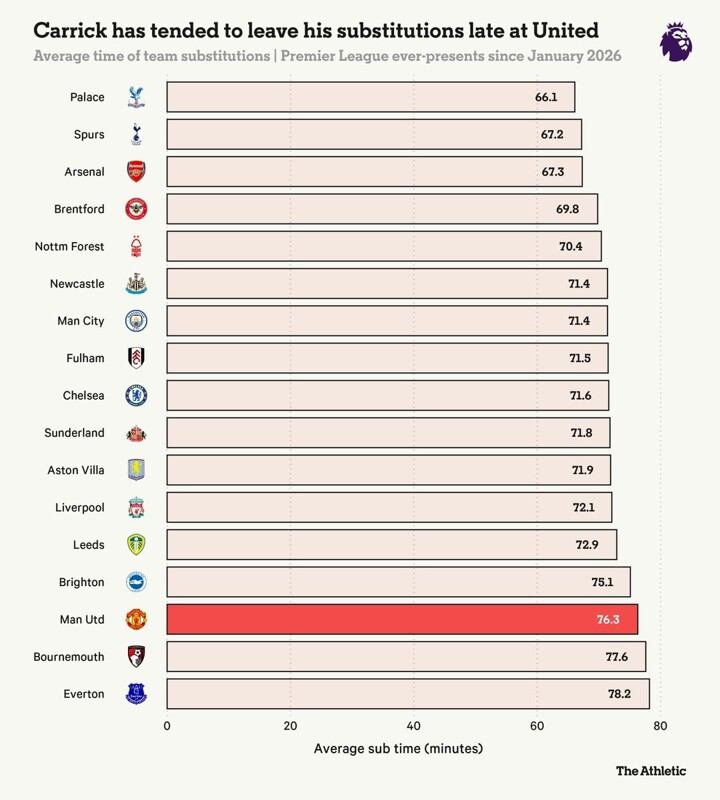
According to data, since Carrick took over Manchester United following Rúben Amorim, his average substitution time ranks among the latest in the Premier League, with only Bournemouth and Everton making substitutions later.
According to Opta statistics, Carrick typically makes his first substitution around the 65-minute mark in the first half. Among all Premier League teams during the same period, this is the third-latest time, with only Bournemouth and Everton making later changes.
However, much of this data pertains to last season. At that time, Manchester United rarely needed to actively change the flow of the game, and with no European competition or cup distractions, there was little need for player rotation. Therefore, Carrick felt no pressing need to frequently use the bench.
However, this season the situation has changed. Across Manchester United's first seven matches in all competitions, against Hull City they trailed by two goals in the first half, against Manchester City with ten men they conceded first after struggling for an hour, in the League Cup against Brighton they led 2-0 at halftime but lost the lead by the 66th minute and eventually lost, and away at Fulham they fell behind in the 63rd minute.
These matches show that Carrick's need to actively change the flow of games has increased significantly.
Carrick's average time for all substitutions is 76.3 minutes, but when Manchester United is behind, this figure moves up to 69.1 minutes. This suggests he is not completely lacking in urgency and has made decisive adjustments in the past.
For example, against Hull City he made a halftime change, removing Patrick Dorgu and introducing the more attacking Marcus Rashford. Previously, against Everton, with the score 0-0, Carrick brought on Alejandro Garnacho in the 58th minute, and he eventually scored the winning goal.
However, overall Carrick has shown considerable restraint in his use of substitutes this season.
This is not a new issue. Carrick faced criticism for this during his time as Middlesbrough manager, and after Manchester United lost to Leeds United at Old Trafford in April, his substitution choices were again the focus of discussion.
In that match Manchester United were already 0-2 down at halftime, and Lisandro Martínez was sent off in the 56th minute, yet Carrick did not make his first substitution until the 70th minute.
When asked about the substitutions a week later, Carrick responded: "There are many factors to consider with substitutions. Looking back at our matches since taking over the team, I think our substitutes have actually had a very positive impact."
"Of course, we analyze what we can learn from every match, but I don't think how often substitutions are made, or when they're made, or comparing that data to other teams is that important. What matters is the result, and overall we've gotten good results."
At least at that time, Carrick had reason to say so. Last season, Alejandro Garnacho was an excellent impact substitute, scoring late winners against Everton and Fulham, and scoring a leveler against West Ham United during a four-game stretch in February.
In January this year, when Manchester United beat Arsenal 3-2, Mateus Cunha scored the winning goal just 20 minutes after coming on as a second-half substitute.
However, the situation is different this season. To date, the only clear instance where Carrick's substitutes have had significant impact is against Everton when Garnacho came on to help Manchester United take a 2-1 lead, though Ainsley Maitland-Niles equalized in extra time.
One key reason Carrick cannot change matches with substitutes the way he did last season is that his options are limited due to injuries.
Garnacho missed preseason with a shin injury and is still working to regain full fitness. That same injury may now have recurred, requiring rest. Amad is also recovering from injury and has not featured this season.
One striker not at full fitness and one winger unavailable may not seem like a serious problem, but it has forced other players to play out of position, leaving Carrick short of a truly trusted, proven attacking option on the bench to change a match.
The away trip to Fulham before the international break is a typical example. Manchester United fell behind in the 63rd minute, and Carrick did not make a substitution until the 77th minute, drawing criticism.
However, the attacking options available on the bench at that time were actually only Joshua Zirkzee, Dorgu, Mason Mount, and 19-year-old Shea Lacey. All players except Lacey were eventually brought on, and Dorgu played as a left-back.
Therefore, it would be unfair to simply blame Carrick for deliberately keeping game-changing players on the bench. What's truly worth discussing is whether he can deploy his existing players more effectively and boldly.
For example, Rashford is currently one of Manchester United's most dangerous attackers, and leaving him out of the starting lineup is clearly very risky. But could his abilities be better utilized if Cunha started on the left wing? And could Rashford be used as a "super sub" to change the game in the second half?
This plan depends somewhat on Amad's potential return. If Amad returns to the squad, Brayan Mbeumo could move from the right wing to a more central attacking role, allowing him to rotate with or share minutes with Garnacho if he features.
Another candidate worth considering is 19-year-old Lacey. He scored in the League Cup loss to Brighton in his first-team competitive debut for Manchester United. However, in the first five Premier League matches this season, he has played only 10 minutes total. The Athletic believes Carrick could consider using this young player as a "wildcard" to break deadlock situations.
Currently, Manchester United has won just one of their last five matches and ranks 12th in the Premier League. In this situation, continuing to try new player combinations has become something of a necessity.
Carrick has always preferred continuity and stability in his squad. However, when Manchester United performs poorly, this approach can easily be interpreted by outsiders as a lack of proactive adjustments.
If the team's results do not improve quickly, Carrick may need to abandon this relatively cautious approach and adopt a bolder strategy regarding substitutions and player deployment.
AI 번역.
AF PC사이트가 오픈했습니다! 컴퓨터에서 전체 뉴스, 댓글, 경기 상세 정보와 데이터를 확인하세요. 방문하기: www.allfootballapp.com
 Манчестер Юнайтед
 Майкл Каррик (капитан)
Все комментарии