
Former Premier League referee Graham Scott has argued in an article for The Athletic that only the use of excessive force and brutality constitute violent conduct. Although Rice's action was reckless, it did not warrant a red card. Scott's comments addressed the controversial incident involving Rice in the closing moments of Arsenal's match against Brighton & Hove Albion.
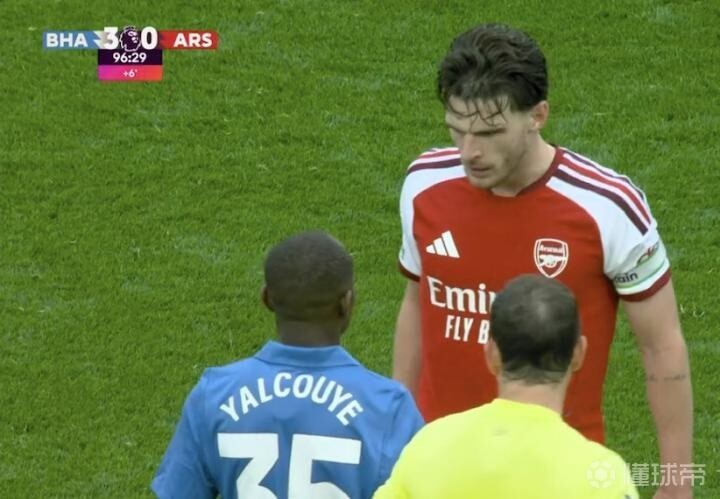
Arsenal endured a frustrating afternoon, with Rice losing his composure in the dying minutes of the match.
At Brighton & Hove Albion's stadium, Arsenal were trailing 3-0. Late in the game, Brighton player Malick Yalcouye chased down Rice. After the English midfielder played the ball, Yalcouye caught him from behind with his shoulder. Rice then ran towards Yalcouye, made a kicking motion with his right foot, and tripped him.
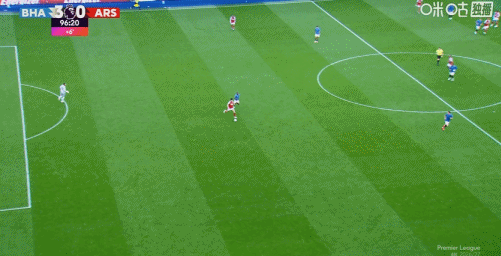
The referee ultimately gave Rice a yellow card, but the decision still sparked debate: was Rice fortunate to escape a red card?
Many compared the incident to Foden's kick on Bruno Fernandes in the Manchester derby the previous weekend, which resulted in a red card.
However, there were crucial differences between the two incidents. The Athletic examined the definition of violent conduct to explain why Rice remained on the pitch while Foden was sent off.
What Do the Rules Say?
The Athletic reported that the Premier League's match centre (responsible for referee appointments for all Premier League matches) agreed that Rice's challenge was not violent conduct and should not have been a red card.
According to the Laws of the Game, violent conduct is defined as a player using or attempting to use excessive force or brutality against an opponent when not competing for the ball.
Rice's action was deemed reckless rather than violent. VAR only recommends a review when an on-pitch offense meets the threshold for a red card, so the video assistant referee did not intervene.
Former Newcastle United and England striker Alan Shearer said on air that the referee's decision was correct.
"Rice simply lost his temper; Yalcouye gave him a small push," Shearer said. "I think the referee got it right. It wasn't an excessive action—he didn't really strike his opponent hard."
What Is the Fundamental Difference With the Foden Incident?
In Manchester City's match against Manchester United at Old Trafford, City forward Foden fell after being shoved by Fernandes near the touchline; Fernandes then raised his foot and appeared to kick Foden, though his foot also came very close to the ball.
In retaliation, Foden, who was on the ground, raised his foot and kicked Fernandes in the abdomen, knocking the Portuguese player down. Referee Oliver immediately showed Foden a red card, while Fernandes received a yellow card.
Following the incident, Webb stated the decision was correct and that Foden's action crossed the line into violent conduct. Webb also noted that the Manchester United captain Fernandes's "retaliatory kick" should have resulted in a yellow card.
"I agree that Foden received a red card for violent conduct. He kicked Bruno Fernandes in the upper body with force," Webb said. "João Gomes of Aston Villa was sent off for a similar action. It was a decision made by the on-pitch referee.
"Upon review, Fernandes made a retaliatory kick that caught Foden in the lower back. That action was more emotional in nature and did not constitute violent conduct. Violent conduct must involve excessive force or brutality.
"In slow motion, his action did not meet the threshold for violent conduct and could only be a yellow card, and VAR does not have the power to rescind a yellow card.
"If the on-pitch referee had completely missed the offense and taken no action against Foden, then VAR could have intervened: first, to check whether Foden's action warranted a red card, and second, to issue Fernandes a yellow card. But because the referee had already sent Foden off, VAR had no scope to act."
Graham Scott's Analysis
(Graham Scott served as a Premier League referee for ten years and officiated over 100 matches as a VAR official.)
What constitutes violent conduct in football has always been contentious. However, in Rice's challenge against Brighton & Hove Albion, I believe there were insufficient grounds for a sanction harsher than a yellow card.
A red card for violent conduct requires either excessive force or brutality, and the physical contact between Rice and Yalcouye possessed neither. The action was provocative, reckless, and utterly pointless, but it was not violent conduct.
I suspect the referee did not see the full incident clearly, but likely caught an altercation between the two players from his peripheral vision. The fourth official appeared to have a clear view of the entire incident and relayed information to the referee.
One crucial detail: the fourth official would need to reach for the switch on his belt, which must be activated to enable the microphone. Fourth officials typically keep their microphones off to prevent constant trivial complaints from the bench from interfering with the referee.
Whether making on-pitch decisions or reviewing footage, referees face a dilemma when defining violent conduct: such incidents are rare, so there are few precedents to reference.
Last season, three players were sent off for briefly pulling an opponent's hair, and three others received red cards for kicking an opponent in the groin from below—Foden's action in the Manchester derby fell into this category.
Following a rule review last summer, the standard for brief and unintentional hair pulls was relaxed; however, there is now general consensus in football that actions like Foden's should result in a direct red card. The Independent Major Incidents Panel will announce its latest findings this week, and we await the results.
Over the past year, only one incident was somewhat similar to this situation: a player deliberately tripping or kicking an opponent who was already moving away. Chelsea's Estêvão's challenge on Leeds' Guðmundsson involved significantly greater force, yet he received only a yellow card.
Traduit par IA.
Le site web d'AF est désormais en ligne ! Actualités complètes, commentaires, détails des matchs et statistiques sur votre ordinateur. Visitez : www.allfootballapp.com
 อาร์เซนอล เอฟซี
 แมนเชสเตอร์ ซิตี้ เอฟซี
 ไบรท์ตัน
 เดแคลน ไรซ์
 ฟิล โฟเด้น
 มาลิค ยัลคูเย่
ความคิดเห็นทั้งหมด