
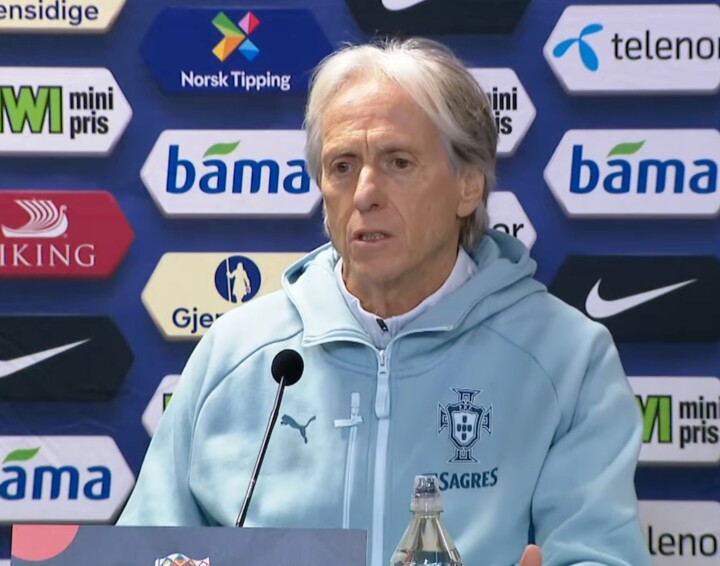
Ahead of Portugal's away UEFA Nations League match against Norway, head coach Jorge Jesus attended the pre-match press conference. He discussed Norway's high press, Bruno Fernandes' injury, whether Ronaldo would start, and his considerations for Bernardo Silva's midfield role.
In your second game in charge of Portugal, you're facing Norway away—possibly their strongest team in thirty years. They haven't lost at home in a long time. Would you have preferred such a challenge later in the schedule rather than so early, in just your second game?
Of course. Playing four games in just a few days, I certainly wish I had more time. However, these matches will also help me understand the team better. I didn't have a complete preparation period, and neither did other newly appointed national team coaches. I even specifically checked the results of their first games: only the French coach and I won; everyone else failed to secure a victory.
Through these games, I will review and analyze with the team: what we did well and what we did poorly. But we are working while playing official matches. This isn't a pre-season; we don't have time to build a solid foundation before competing. However, this is not an excuse. You have to accelerate, find solutions, and be creative.
When you hear me mention indoor training, it might be hard to understand what it actually is or under what circumstances it's conducted. I have to make up for lost time this way, then bring that content into the limited on-field training time we have to help players understand my ideas as much as possible. I cannot arrange extensive contact training or opponent-based drills now because players are still recovering from the last match and have another game tomorrow. We must be cautious. I've been in football for many years; this situation won't faze me.
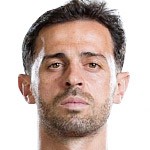
I want to talk about Portugal's midfield, not necessarily just for tomorrow's game, but for the future as well. Earlier this week at the training base, you divided the players into two groups: one for attacking midfielders and forwards, and the other for defenders and defensive midfielders. For at least the first fifteen minutes we were able to watch, Bernardo Silva was in the latter group. Do you envision him playing as a defensive midfielder in the future?
He is currently playing in that area for Real Madrid. I even went to Madrid specifically to watch one of his games. I think in the future he can play as a more advanced midfielder alongside a defensive midfielder; he can also cut inside from the wing, but not as a traditional winger. How he plays specifically will depend on the coach's ideas.
For example, when the team plays a 4-3-3, if the other two midfielders are at a disadvantage in physical duels, he can be the third midfielder to cut inside and help them. There are many different angles to consider to maximize a player's effectiveness.
However, you also asked earlier why the forwards and defenders were separated in that training session, and I can explain that too. It was our first training together, and we also needed to prepare for the match against Wales. I arranged it as a pre-match warm-up. If you paid attention to the warm-up on match day, you would find that the content was exactly the same as that training.
You mentioned concerns about the first phase of build-up play from the back because Norway might apply strong high pressure. Given this, will you adjust the centre-back pairing and bring in a player with different build-up characteristics? Or will you maintain the current defensive line? Also, will João Neves be available tomorrow?
When there are only two or three days between matches and I need to rotate the squad, if no one in defence is injured, I usually don't change the defensive players. I think it will be the same tomorrow. As for João Neves, he had a minor issue when he arrived from Paris Saint-Germain. I spoke with him, and he had an MRI scan. Now that the game against Wales is over, I can tell you: I told him then, "I won't play you in this match, but I will play you against Norway." He will play tomorrow.
We haven't discussed Ronaldo yet. Before the Wales game, you said his situation was straightforward: if he performs well, he plays; if not, he doesn't. He started that match, and one of his goals was disallowed. After seeing his performance in your first game in charge of Portugal, do you think he should continue to start against Norway tomorrow?
Don't forget, we still have a training session. I don't know what will happen yet; hopefully there are no surprises.
Okay. Then, back to the previous question: based on his performance against Wales, do you think he should start tomorrow?
First, let's talk about his performance in that game. We had fifteen shots inside the box. I'm not saying all fifteen were on target, but fifteen shots occurred inside the penalty area. Seven of those were taken by Ronaldo, with two on target. This means he had seven opportunities to shoot. Compared to his recent games, this is already quite a lot. In some games, he might only have one or two chances, or even none at all.
Of course, he can do better. And he came very close to scoring. As for tomorrow, I will assess his condition today, and I've already spoken with him before. He played sixty-five minutes in the last game. I will look at his physical condition and then decide whether he starts or comes off the bench.
Whether we want to admit it or not, Cristiano is different from João Neves. João is only twenty years old; perhaps he can play every three days or two games in a row. We have to take these factors into consideration. So we'll see. Today's training will give me more insight into Cristiano's condition.
Given that you coached Flamengo in Brazil, I'd like to hear your perspective as a foreign coach on the decision by Brazilian clubs to reduce the number of foreign player slots. Currently, each team can register nine foreign players per game; next year it will decrease to eight, then gradually to five by 2030. What are your thoughts?
That's an interesting question. Recently, when coaching in different countries, people often ask me similar questions. Sometimes it's during interactions with football associations, like in Saudi Arabia; in Turkey, I was also asked whether a country should reduce the number of foreign players. My view is the same when I discuss this in Portugal.
Brazil gradually reducing the quota from nine to five will not necessarily improve the level of Brazilian players, nor will it improve the quality of Brazilian football. I always use Portugal as an example. Portugal is one of the best countries in Europe for developing players and has always had very talented players. But in Portugal, if the coach wishes, all eleven starters can be foreign players. We still constantly produce excellent players and will continue to do so, because the issue is not about foreign player quotas.
What's truly important is youth development, the quality of player training, and competition scheduling. Brazil does one thing well with competition scheduling, though they might not realize it themselves. I truly hope they never abolish the state leagues; they are one of the secrets to the development of Brazilian players.
If I heard correctly, you said you would decide after training today whether Ronaldo starts or comes off the bench. Is there a possibility he won't play at all tomorrow?
I already answered that question for the Portuguese journalists. I still don't know if Ronaldo will start tomorrow, but one thing I do know is: even if he doesn't start, he will be a player I consider bringing on; he will play tomorrow. From now until tomorrow, I will continue to monitor his condition. He knows his body better than I do, after all, he has been playing for many years. Today's training will also give him an understanding of his condition, and then he will talk to me.
Regarding the attention Ronaldo receives
The attention Ronaldo receives is a worldwide phenomenon. He himself is a global phenomenon. This comes from his playing career and also from a record he is still chasing: scoring a thousand goals. He is a role model for a new generation, including young people who don't even play football. I've noticed that many of his fans are teenagers. Many of them, perhaps even most, have never seen him play live. So, he is indeed special. He is part of the Portugal team, and whether he plays or not, he remains very important to Portugal.
AF's PC site is now live! Browse full news, comments, match details and stats on your computer. Visit: www.allfootballapp.com
 ปารีส-แซงต์ แชร์กแมง
 นอร์เวย์
 โปรตุเกส
 เรอัล มาดริด
 เอเเอล นาส์ร เอฟซี
 คริสเตียโน โรนัลโด
 จอร์จ เชซุส
 แบร์นาโด ซิลวา
 ชูเอา เนเวส
ความคิดเห็นทั้งหมด