
According to The Athletic's analysis, Michael Carrick's tenure at Manchester United last season, following his appointment, yielded significant success through a stable starting lineup, a 4-2-3-1 system, and relatively simple and clear tactical ideas. He ultimately guided the team to third place in the Premier League and secured Champions League qualification. However, as the new season began, opponents started to find ways to counter this approach. Carrick, now the permanent manager, is being asked to introduce more tactical variations, and his timing of substitutions is increasingly under scrutiny.
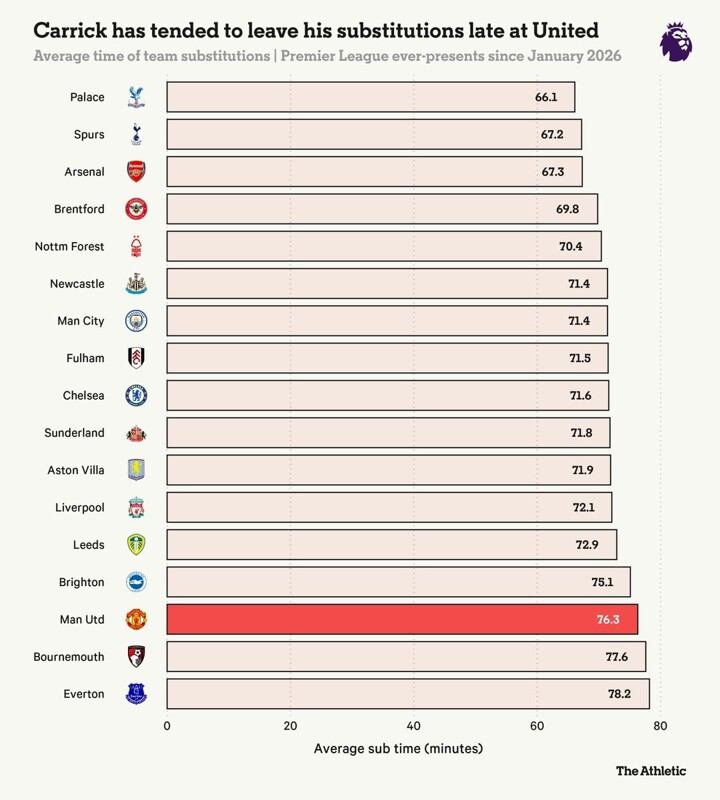
Data shows that since Carrick took over from Ruben Amorim, Manchester United's average substitution time has been very late in the Premier League, with only Bournemouth and Everton making later changes.
According to Opta statistics, Carrick typically makes his first substitution around the 65th minute. This is the third latest among all Premier League teams during the same period, with only Bournemouth and Everton making changes later.
However, most of this data comes from last season. At that time, Manchester United rarely needed to actively change the flow of a game. They also had no European or cup competitions to distract them, and the need for player rotation was not high. Therefore, Carrick had no need to frequently use his bench.
But the situation has changed this season. In Manchester United's first seven games across all competitions, they were two goals down in the first half against Hull City; they conceded the first goal after battling for an hour against a 10-man Manchester City; in the League Cup against Brighton, a 2-0 lead established in the first half was squandered by the 66th minute, ultimately leading to a loss; and away at Fulham, they fell behind in the 63rd minute.
These matches indicate that the situations where Carrick needs to actively change the game's momentum have significantly increased.
The average time for all of Carrick's substitutions is 76.3 minutes, but when Manchester United are trailing, this figure drops to 69.1 minutes. This suggests that he is not entirely lacking in urgency and has made decisive adjustments when necessary.
For example, against Hull City, he replaced Patrick Dorgu at halftime, bringing on the more offensive Marcus Rashford. Earlier, against Everton, with the score still 0-0, Carrick brought on Benjamin Sesko in the 58th minute, who eventually scored the only goal of the game.
However, overall, Carrick has remained quite restrained in his use of substitutes this season.
This is not a new issue. Carrick was criticized for this during his time managing Middlesbrough, and his substitution choices also became a focal point of discussion after Manchester United lost to Leeds United at Old Trafford in April this year.
In that match, Manchester United were already 2-0 down in the first half, and Lisandro Martínez was sent off in the 56th minute, but Carrick didn't make his first substitution until the 70th minute.
When asked about his substitutions a week later, Carrick responded: "There are many factors to consider when making substitutions. Looking back at the games since we've been in charge, I think the substitutes have actually had a very good impact."
"Of course, we analyze what we can learn from each game, but as for how many substitutions were made, when they were made, and comparing that data to other teams, I don't think it's actually that important. What's important are the results, and overall, we've achieved good results."
At least at the time, Carrick had good reason to say that. Last season, Sesko performed outstandingly as a substitute. During a run of four consecutive games in February, he came off the bench to score late winners against Everton and Fulham, and also scored an equalizer in a draw against West Ham United.
In Manchester United's 3-2 victory over Arsenal in January this year, Matheus Cunha also scored the winning goal 20 minutes after coming on as a second-half substitute.
However, the situation is different this season. Currently, the only clear case where Carrick's substitutions have had a significant impact is when Sesko came off the bench against Everton to help Manchester United take a 2-1 lead, though Ainsley Maitland-Niles later equalized in stoppage time.
One important reason Carrick cannot change games with substitutes as he did last season is that his options are limited by injuries.
Sesko missed pre-season with a shin injury and has been recovering his best physical condition since. Now, the same injury has flared up again, and he may need a rest. Amad has also been recovering from injury and has not played this season.
One striker not fully fit and one winger unavailable might not seem like a serious problem, but it has forced other players to change positions and left Carrick lacking proven attacking options on the bench who can directly change a game.
The away game against Fulham before the international break is a prime example. Manchester United fell behind in the 63rd minute, but Carrick didn't make changes until the 77th minute, drawing criticism.
However, the attacking options on the bench at the time were effectively only Joshua Zirkzee, Dorgu, Mason Mount, and 19-year-old Shea Lacey. All players except Lacey eventually came on, with Dorgu even playing at left-back.
Therefore, it is unfair to simply attribute the problem to Carrick deliberately keeping game-changing players on the bench. The real question is whether he can utilize the available personnel more effectively and boldly.
For example, Rashford is currently one of Manchester United's most dangerous attacking creators, and dropping him from the starting lineup would clearly be very risky. But if Cunha were to start on the left, could his abilities be better utilized, while Rashford is used as a "super sub" to change the game in the second half?
This plan also depends somewhat on Amad's return. If Amad comes back into the squad, Bryan Mbeumo could move from the right wing to the center-forward position, rotating or sharing game time with Sesko if he is available.
Another candidate to consider is 19-year-old Lacey. He scored in his first-ever start for Manchester United's first team in the League Cup loss to Brighton. However, in the first five Premier League games this season, he has only played a total of 10 minutes. The Athletic suggests that Carrick might consider using this young player as a "wild card" to break the deadlock.
Currently, Manchester United have won only one of their last five matches and sit 12th in the Premier League. In this situation, continuing to experiment with new personnel combinations has become somewhat necessary.
Carrick has always favored continuity and stability in his lineup. But when Manchester United's results are poor, this adherence can easily be interpreted by outsiders as a lack of proactive adjustment.
If the team's performance does not improve quickly, Carrick may have to change this relatively cautious approach and adopt a more daring strategy regarding substitutions and personnel usage.
AF's PC site is now live! Browse full news, comments, match details and stats on your computer. Visit: www.allfootballapp.com
 แมนเชสเตอร์ ยูไนเต็ด เอฟซี
 ไมเคิล แคร์ริก
ความคิดเห็นทั้งหมด