
Following a 0-2 defeat to the United States in the second match of the FIFA World Cup group stage, Australia head coach Tony Popovic attended a press conference.
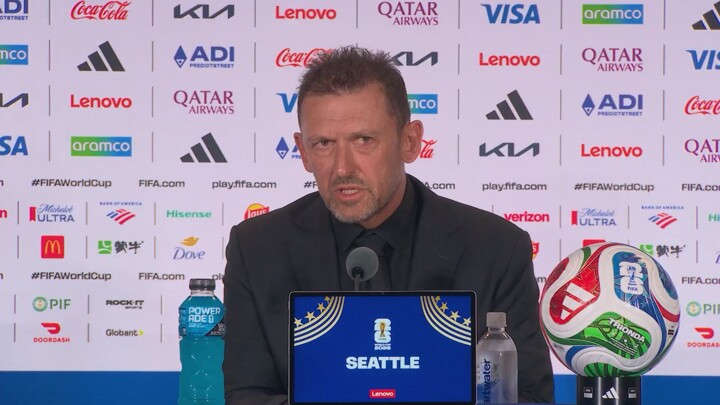
Tony, the first and second halves were very different. Can you explain what happened early in the match? It seemed like you were under pressure from the start—was that due to nervousness, the magnitude of the match, or was there something about the US team that caught you off guard?
No, they didn't catch us off guard. Their quality is very evident, their strengths are clear, and their athleticism is obvious. So there was nothing they showed us that truly surprised us. We simply couldn't match them in the first half. We struggled to win the ball, struggled to get second balls. We were a step behind in everything we did and couldn't establish any foothold in the match, which made it very difficult. Look, we conceded a couple of goals that were, frankly, too easy for us to give away. But overall, we were clearly ineffective and lacked intensity in the first half.
Tony, I want to ask about that point. Why do you think you were so ineffective and lacked intensity? Why did the US always get to the ball first? I noticed you made several changes at halftime—was that due to personnel issues? What's your take?
Well, you can always consider whether it's a personnel issue, but I'm not sure changing players at halftime would have made a huge difference. You see, the pitch was hot, it was difficult, and it was hard to play. And I don't think the substitutes would have lasted long if they'd started. So in the second half, we needed fresh legs and better concentration. But we also have to give credit to the opposition. They're excellent for a reason. Overall, I was very pleased with the players' response because, as you know, we're an inexperienced team at this level, lacking top-flight experience and accumulated playing time.
But facing that intense physical and mental pressure, they could have easily collapsed, and instead we responded very well. So I'm genuinely very satisfied with our second-half performance. If we'd converted the chances we created and could have seen what happened next, it would have been much better. But everyone should be very pleased with how we responded after halftime.
Tony, you've been nothing but complimentary about the US team. How different is this US team from the one we saw in that friendly in October? And based on how strong this US team looks, do you think they can go further in the World Cup than previous US teams?
Well, they've already qualified, so they've achieved the first part of their objective. But yes, as I mentioned at the press conference before the match yesterday, I've been impressed with them since October, and now they're even stronger—very strong and very cohesive. They have many quality players, and even their substitutes bring considerable experience and high quality. They controlled the tempo of the match very well in the first half.
Unfortunately, conceding just before halftime was a big blow for us—a real blow. But as I said, we matched them well in the second half. Overall, while our goalkeeper barely had to make any saves throughout, the US clearly delivered a superior performance in the first half.
What did you think of the physical nature of the match? I noticed seven yellow cards were issued—the most so far in the tournament, even early on. Both teams played with pride and fought hard, but what's your assessment of the physical aspect of the game?
No, I don't think the match was overly physical. Honestly, it's what you'd expect at a tournament of this level like the FIFA World Cup. I actually thought the referee called too many fouls. Sometimes you don't need to do much to win a foul, other times you have to work very hard for one, but that's for the referee to make their own judgment calls. Overall, I didn't think the game was too physical.
Hello Tony, did your players' second-half performance give you more food for thought when selecting your squad for the upcoming match against Paraguay? You mentioned the team was "ineffective" earlier—were you surprised by how that was such a characteristic of the first half?
Yes, that's how it looked at the time. I thought the players were well prepared, but sometimes the magnitude of a match has an impact. We couldn't gain any traction in the game, and without winning the ball or getting second balls, it's very hard to play well. But in the second half, we had most of the possession and dominated the second balls. Looking at the bigger picture, we entered the box far more frequently than they did.
But making up such a big first-half deficit was difficult. I thought our substitutes performed brilliantly and had a very positive impact. We replaced a 21-year-old striker with another young player—a subtle change. He found the second half physically very demanding. As you know, we're talking about an explosive player, but he cramped up on the pitch. So all these things are factors to consider. But I was very pleased with his mental resilience in overcoming that difficult moment. He made an impact. Jason Geria played well, Connor Metcalfe played well, and Cristian Volpato also played well when brought on.
All the players' performances throughout the second half were very encouraging for us. Even those who played in the first half and continued into the second half made a strong impression. So they responded from the first half, put that experience behind them, really elevated the tempo, and improved the quality of their play. But unfortunately, our first-half performance still cost us dearly.
Hello Tony, your team has played in front of large crowds before—notably against Mexico at the Rose Bowl with 80,000 fans, which was reportedly a hostile atmosphere. What was the atmosphere like today, and how do you think it affected your team?
I'm not sure. That's really a question for the players. Yes, it was a great atmosphere, and we're grateful to all the home fans who came to support their team. But as you know, we also had a strong support base, and they made a lot of noise. In the second half, you could feel our team's involvement back in the match. So we felt the backing of our supporters—it was a wonderful moment. The US team will rightfully go home happy with the win, and we should be satisfied with our second-half performance. This is something we can build on. We still have a good chance to advance, and we know our destiny is in our own hands.
Tony, I wanted to ask first: Mohamed Touré came out at the start of the second half and seemed a bit out of sorts. Was that an injury, or was it a tactical decision? And second, you've hinted at it but haven't directly addressed it—can you explain the two lineup changes? Néstor Irankunda and Connor Metcalfe dropped out, and Matt Leckie and Nish Velupillay came in. Why did you think those changes were right for this match?
We didn't want to use the same starting 11, and now we can see why. In hindsight, we might have made more changes. When you see how difficult this match was and knowing the US team's strengths, we also base our decisions on what we see in training and how players recover physically and mentally from matches. We wanted to maintain freshness in the wide areas, which allowed us to bring on more explosive players in the second half.
AI 번역.
 Úc
Úc
 St. Pauli
 Albirex Niigata
 Mỹ
Mỹ
 Sassuolo
 Tony Popovic
 Jason Geria
 Connor Metcalfe
 Cristian Volpato
 FIFA World Cup
Tất cả bình luận (2)