
Xavi recently had an in-depth interview with Indian podcast host Prakhar Gupta. In the fifth part of this exclusive interview, Xavi discussed topics including "tiki-taka is not an internal term," his positional change, the conflict between Ibrahimovic and Guardiola, the six trophies in 2009, and the 2011 Champions League final.
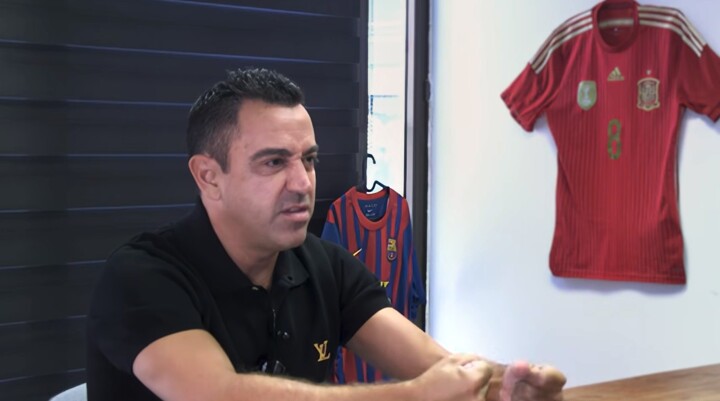
That's interesting. So the term "tiki-taka" wasn't regularly discussed in the dressing room back then? For example, emphasizing one-touch passing and quick ball progression?
No, "tiki-taka" is mainly a term inflated by the media. What we discussed internally was about passing, ball control, playing the ball to the strong foot or the supporting foot. "The pass needs to have the right weight, reach the right foot, with a good first touch, then look up and assess the situation." That was our core philosophy. Beyond that, "rondos"—every training session started with rondos, 7 vs. 2 or 6 vs. 2. Mistakes and losing the ball were strictly forbidden; whoever lost the ball had to go in the middle to press. That's the basic logic behind our approach.
So your role in the team was to find spaces and deliver outstanding passes. You were at the center, not a defensive midfielder, but rather a conductor controlling the midfield, maintaining ball control and distributing forward. Your instinct was to sense all the spaces on the pitch.
Exactly, and including the decisive passes, especially the final pass into the penalty box. Early in my career, my position was actually more defensive. But then Frank Rijkaard enlightened me: "No, Xavi, you're completely capable of playing as an 8 or even a 10, making the final pass and playing a more decisive role in the attacking third." At first, I was even a bit resistant. I told Rijkaard: "Frank, I'm not comfortable in this position. I prefer playing deeper, controlling the entire pitch." He said: "No, Xavi, you need to orchestrate play and make the final pass. Receive the ball, break the lines, and make runs into the box to finish." This positional shift forward completely changed my life and career.
Did Ibrahimovic arrive before or during this period?
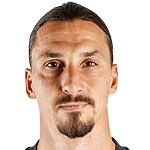
Zlatan was only at the club for one season, 2009-2010. In 2009, we won the Spanish Super Cup and La Liga, but we couldn't defend our Champions League title. We were eliminated by Inter Milan in the semi-finals.
And then Inter beat Bayern in the final.
That's right, at the Bernabéu.
Yes, 2-0, Milito scored both goals.
You really know your football!
Pretty knowledgeable. (Laughs) I remember watching that match. What exactly went wrong with Zlatan at Barcelona? Because he seemed out of place at the time and later made some critical remarks.
With Zlatan, our personal relationship in the dressing room was actually very good. The real issue was between him and Pep. Pep trusted Zlatan for most of the season, but in the final three months, he dropped him from some important matches in favor of Bojan. That's where the tension started. Then Guardiola suddenly made it clear to him: "You're no longer in the team's plans. You need to find another club." That's basically what happened.
But Zlatan has a very strong personality, doesn't he? Was he like that in the dressing room?
I really appreciate Zlatan. Yes, I do. I appreciate him because he's extremely funny and witty. He never stops talking during training sessions, always cracking jokes and making everyone laugh. We were very close, and now he's back at AC Milan in a management role, and we still keep in touch. The conflict was definitely not in the dressing room, absolutely not.
A tactical incompatibility?
Exactly. I have great memories of Zlatan in the dressing room; he was always joking around. Sometimes his thinking was a bit crazy, but that's just Zlatan, you know.
His finishing was extraordinary too, because with him, you never know what incredible position he'll shoot from or where the ball will end up.
That's true. Sometimes he's an absolute genius. Everyone would exclaim: "My God, how did he score that! It's incredible!" But sometimes he would inexplicably mess up a simple pass; his form was quite inconsistent. However, his talent is absolutely world-class. Two meters tall with that kind of flexibility and ball control, he's an extraordinary superstar.
In 2009, you won every trophy possible. The unprecedented sextuple. That's right. My friend, looking back now, does it still feel surreal? It was just...
To this day, I believe 2009 was the peak year of my career. I was 28, 29 years old, at the prime age of complete maturity both mentally and in experience. In my view, ages 28 to 31, 32 are the golden peak years for playing football. That's been my personal experience as a player; I absolutely loved playing on the pitch during that time. We won every trophy possible, with the national team, with Barcelona, everything went smoothly. Everyone remembers David Villa joining after that, and we lifted the Champions League trophy again in 2011 at Wembley. That was one of the most perfect matches I ever played in my career. That final against Manchester United was a masterpiece. Even in the second half, we felt winning the final was surprisingly easy. Initially, outsiders predicted a difficult match, but we controlled the entire game. We had great respect for Manchester United, but that night our performance was vastly superior. I clearly remember the comments from Sir Alex Ferguson, Rooney, and Ferdinand after the match—they acknowledged: "This is the strongest team we've ever faced, truly at the peak of world football."
Sir Alex Ferguson was completely stunned at the time, because he witnessed a spatial dominance, a team with an incredibly solid foundation built by a manager over more than a decade. Manchester United was extremely powerful during that period, but they were completely overwhelmed by you in every aspect, which was truly shocking.
Frankly, we were truly invincible that day. Our tactical system and football philosophy made the decisive difference. Of course, there was also the individual brilliance of world-class forwards like Messi and Villa in attack. But the core remained tactical conception. We controlled the ball, and by deploying Messi deep as a false 9, we firmly established numerical superiority in midfield. Their center-backs didn't dare press easily, and we calmly rotated the ball in midfield, opening up spaces. We could have scored even more goals. At that moment, we truly completely dominated our opponents.
Website AF đã ra mắt! Xem tin tức đầy đủ, bình luận, chi tiết trận đấu và thống kê trên máy tính. Truy cập: www.allfootballapp.com
 MU
MU
 Hà Lan
 Barcelona
 Zlatan Ibrahimović
 Xavi
Xavi
 Pep Guardiola
Tất cả bình luận