
Merino sat down for an interview with TNT Sports, where he reflected on winning the Premier League and the World Cup, discussed the changes brought by fatherhood, psychological adjustments during injury, his mindset when coming on as a substitute, and his experience working with Arteta.
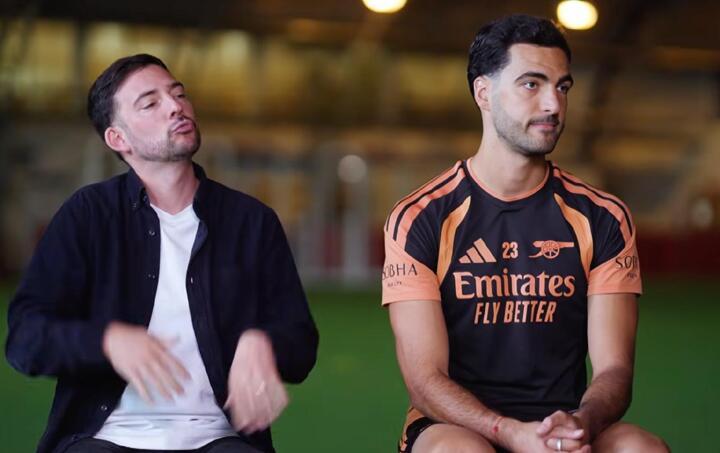
It's been an incredible year for you, winning both the Premier League and the World Cup. Tell us about those experiences and how you feel.
For me, it's been a fantastic year, not just professionally, but also personally. I became a father this summer, so...
Congratulations.
Thank you very much. It's been truly amazing. Even in my wildest dreams, I never imagined achieving so much in such a short time. I'm incredibly proud.
These achievements aren't just mine; I'm proud of everyone at the club and, of course, my family. It's truly been an unbelievable summer.
Do you feel you've changed? You've become a father and won the Premier League and the World Cup. Have these experiences changed you?
Yes, these experiences definitely change you. Professionally, winning titles obviously boosts your confidence. And personally, having a child completely transforms your life; your priorities shift.
Now I'm a father first and foremost; I have my own child. Before, football was the most important thing to me. Now, football is still very important, but family has become the most crucial aspect of my life.
The beginning of this year must have been tough for you. You were injured, and it was a World Cup year. How did you cope psychologically?
It was difficult, honestly. That period was very tough for me. My wife was in the late stages of her pregnancy, and I was injured, unable to even walk normally for two or three months. It was a challenging time for our entire family.
Psychologically, the thought of potentially missing the World Cup was overwhelming. I needed to lean on my family and friends, trying to focus on the positive side. I had more time at home to help my wife and experienced a completely new phase in life. I had never been injured for such a long time before, and I feel I learned a lot from it.
Mikel, everyone knows you're very good at scoring goals after coming on as a substitute. Twice in the World Cup, right? Can you tell us how you feel when you come off the bench and make that kind of impact?
Even thinking about it now still gives me goosebumps. After experiencing the lowest point of my career, to be able to help the team and my country in that way was truly incredible. Scoring those late goals in the 90th minute to help your country advance to the next stage—that feeling is truly unbelievable.
I can tell you that I was very excited at the time, of course. However, I don't think that excitement was completely unexpected, because when you prepare for a game and prepare to come on as a substitute, you're already anticipating such moments.
You think: "Okay, I'm going to make an impact. I'm going to give my best and help the team."
So when it actually happens, you're naturally very happy, but you're also mentally prepared. It's not a huge surprise because you're ready for that moment.
When you know you won't be starting, is it difficult to maintain that mindset and motivation? Or do you have confidence that you'll come off the bench? How do you deal with these situations?
Honestly, it is a challenge. As a professional player, you always want to start; you always want to make an impact because you recognize your own worth and know your abilities. When they tell you that you'll be on the bench, you have to quickly adjust your mindset and shake off that feeling of being undervalued.
Then you have to make an impact on the field to prove to everyone: "Okay, I have this ability, and I can help the team, even if it's just for a few minutes." At the same time, you also need to prove to the coach that you can make an impact. So it is a big challenge. That's why being mentally prepared is so important. When you actually do it, you're very happy because you've helped the team.
Mikel, you just said it's important that when coming off the bench, you need to have confidence and know that you can help the team. But I imagine you also don't want to become too arrogant. So how do you find that balance? To have confidence without becoming arrogant, and to stay grounded.
Yes. I think there's a fine line between confidence and overconfidence or arrogance. For me, my father was also a football player. Growing up, he helped me a lot. He told me that football is a team sport; you're not alone on the field, and the collective comes first.
But at the same time, you also need to have confidence to perform at your best. So the line is subtle. The beauty of team sports is that when a player sometimes strays from this line, teammates can help bring him back on track. That's also the beauty of football.
Both at the club and in the national team, we have a fantastic squad, and everyone helps each other. That's why we've been able to achieve so much together.
What do you think was the core message from the coaching staff this season? This season is a bit different from last season, so what's the message now?
I think the core message is to be proactive this season. The head coach has made that very clear. Some people might think that because we are the reigning champions, we need to defend the title and hold our position. But our mentality is the opposite. Our plan is to approach every matchday as the most important matchday, to be proactive, and to perform at our best.
What's your relationship with Mikel Arteta like? Did you know him before joining Arsenal?
I certainly knew of him, but I didn't know him personally before. My relationship with him is very good. I truly feel honored and lucky to be able to work with him on the field every day. He is arguably one of the best coaches in the world; there's hardly any dispute about that.
I personally love football very much, and I don't know if I'll want to be a coach in the future, so every day I seize the opportunity to absorb everything he says like a sponge. He is willing to share his ideas with everyone and always wants everyone to understand his football philosophy. We are truly very happy to have him at our club.
I don't know if you've heard of him, but there's an NFL American football player named DK Metcalf who is known for celebrating with American Sign Language. Have you heard of him?
Yes, I know him. I'm a big NFL fan. His sign language celebrations became very popular online. That's actually one of the things I wanted to ask you about. Can you teach me some signs or short phrases that I can use the next time I score a goal?
You can start with "Arsenal." This is the sign for "Arsenal."
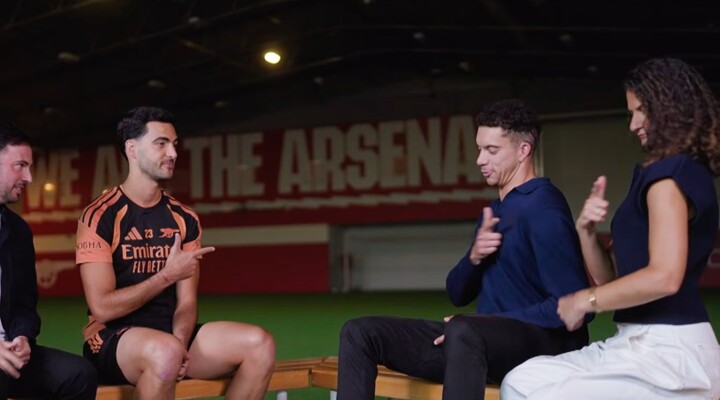
Okay.
That's right, because of the cannon in the badge. You can also express "Love Arsenal." Players also have their own sign language names, which are determined by their playing style or appearance. Actually, you have your own sign language name. Do you want to know what it is?
Of course.
Can you guess?
I have no idea, absolutely none.
What's your goal celebration?
I do a little spin after I score.
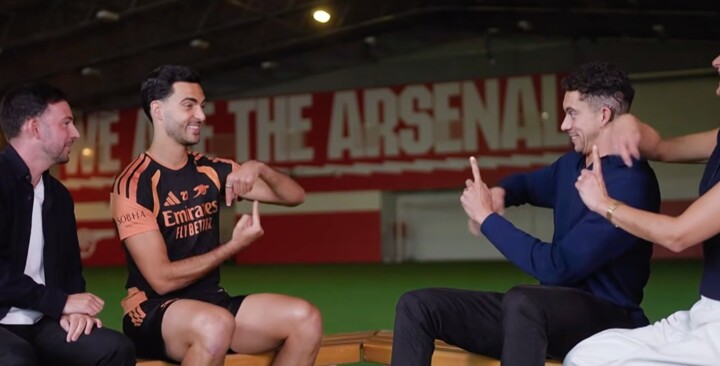
Right, you do that. So that's your sign language name. This represents the corner flag, and this represents you spinning around the corner flag, just like when you celebrate a goal.
That's great, that's great.
You can express "Look at me." So you can say: "Yes, look at me," and then do your sign language name when you score. That would be a great celebration. You have to remember it now.
I will use this move.
You must remember it.
I will definitely remember it.
AF's PC site is now live! Browse full news, comments, match details and stats on your computer. Visit: www.allfootballapp.com
 Arsenal
 Tây Ban Nha
 Mikel Arteta
 Mikel Merino
Tất cả bình luận (1)