
Dominic King, a reporter for The Daily Telegraph, wrote that England's recent string of impressive wins has boosted the team's confidence and raised external expectations, but neither Tuchel nor the FA should celebrate prematurely. Compared to their performance against Spain in September, whether England's true strength has genuinely improved still needs to be tested in higher-level matches.
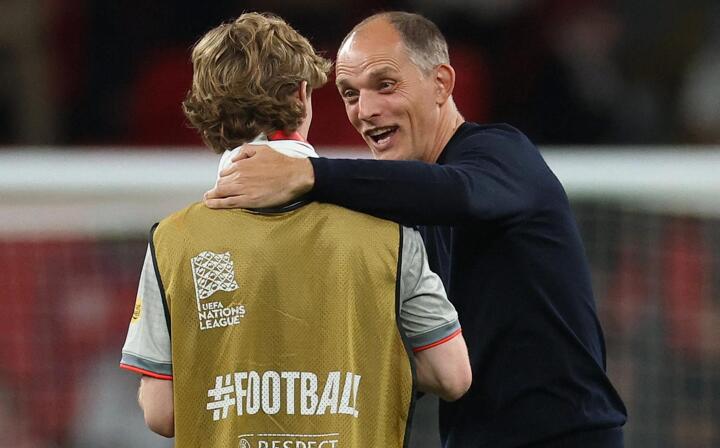
Here is the original translation:
Three weeks ago, Tuchel was still dealing with criticism following the World Cup defeat. Now, it seems he has firmly grasped the European Championship.
There has been a huge shift in public sentiment. Perhaps Tuchel's statement on September 18 that "99.9% of England fans" didn't care what tactics he employed in the infamous World Cup quarter-final against France in Atlanta wasn't an exaggeration.
Fans want to be entertained and enjoy the game, and England certainly delivered on that front, winning at home against the Czech Republic and in an empty stadium in Rijeka against a group of veteran Croatian players. These three matches, from a footballing perspective, were almost laughably easy.
But don't be fooled by these results: it would have been extremely disappointing if England hadn't collected all nine points. However, they did complete the task in an encouraging manner. We always knew this team had some very good players, and now they are clearly also full of confidence.
However, I don't want to be a spoilsport, but shouldn't we temper expectations for what England has "truly achieved" over the past seven days? Shouldn't we continue to remember the loss to Argentina in the World Cup semi-final? The answer to both questions is yes, of course we should remember.
Tuchel is approaching his second anniversary as England manager. When Mark Bullingham, the determined CEO of the FA, opened his checkbook to hire him, his mission was simple: to put a second star on the England shirt.
There was no ambiguity about it. Tuchel initially received a contract covering only one major tournament, then extended it in February this year, with the goal of winning the World Cup. When the truly important moments arrived and he had to make those big decisions at the right time, he failed.
Those who staunchly support Tuchel will tell you that the World Cup in the United States was England's best performance in a major tournament away from home, and they will also point to the third-place match victory over France, earning a bronze medal, as evidence of the team's progress.
However, at times like these, it's crucial not to be misled by the scoreline. In the past few days, we've seen headlines like "Jude Bellingham compared to Zinedine Zidane" and claims that Harry Kane is a better finisher than Cristiano Ronaldo, but you must be clear about what you are truly seeing.
Last Saturday, Croatia's performance in Rijeka was so poor that their usually proud coach, Slaven Bilic, considered it an insult. He couldn't believe his team defended that way, nor could he understand why the players stopped doing things that should be instinctive for footballers – running, pressing, and staying focused.
If only one team truly tries to compete in a match, you cannot call the other team "great" based on such games. England's internal training sessions at St. George's Park during this camp may have been more competitive than the matches they faced along the Adriatic coast, and your eyes will not deceive you.
Similarly, look at Kane's second goal in England's nearly training-like match against the Czech Republic on Tuesday. Newcastle United's Czech goalkeeper, Lukáš Hromada, inexplicably let a not-very-threatening header from Kane slip through his hands into the net. His frustrated expression said it all – it should have been a routine save.
To be clear, this is not a criticism of the England players. None of them have made arrogant statements, and all are focused on achieving success. It is reasonable to expect that even they themselves will not get carried away after beating two teams they were expected to defeat.
But now they face a question: after such huge expectations have been placed on their shoulders, what will happen next month when they travel to Madrid to face Spain? When the two teams met at Wembley last month, world champions Spain were clearly a cut above England; they represent the highest standard.
If England is truly as good as supporters believe, and if Tuchel is indeed the coach who can help the team take the final step, then they should defeat Spain at the Metropolitano Stadium. If they want to be taken seriously, they should approach this competition seriously and prove themselves with a truly convincing performance.
In this country, our attitude towards different competitions is somewhat strange. Many people will tell you that the Nations League is an insignificant competition. But that didn't stop Spain from winning the Nations League in 2023, using it as a springboard to win the European Championship in 2024, and then reaching the top of the world this July.
Portugal has won the Nations League twice, and France has also won it. These teams have one thing in common: in the past 10 years, they have all achieved success in the highest level of international competition. If England hopes to win a championship in 2028, wouldn't winning one in 2027 be a great starting point?
If England can achieve that, perhaps we can truly turn the page on the World Cup loss to Argentina. But at least for now – and perhaps this means we are among the "0.1%" Tuchel spoke of – three easy victories have changed nothing beyond making the statistics look better.
For Tuchel and the FA, it is far too early to celebrate.
AF's PC site is now live! Browse full news, comments, match details and stats on your computer. Visit: www.allfootballapp.com
 英格兰
英格兰
 图赫尔
图赫尔
全部评论