
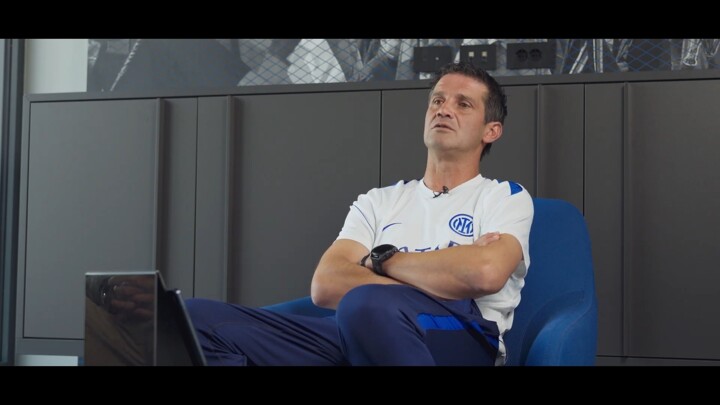
Inter Milan head coach Simone Inzaghi, in an interview with the renowned Italian football podcast "Cronache di Spogliatoio," discussed goalkeeper challenges and player development. This is the fourth part of the interview.
Related Reading
【Chivu: I Still Consider Myself a Student; If Not, I Better Not Be in This Business】
【Chivu: Victories and Defeats, Success and Frustration Should Be Treated Equally】
【Chivu: If Attackers Don't Have Strong Conviction in High Pressing, Demands Are Useless】
【Chivu: Don't Underestimate Stankovic Jr.; We Will See Him Shine Sooner or Later】
In your football philosophy, can we say this: you like attacking football, you like ball possession, and dominating the game?
Yes, I love playing possession-based football because, fortunately, there's a ball in football. When you have possession, you need to know how to use it to perform certain technical actions. Similarly, when you don't have the ball, I also enjoy finding the right balance and the best way to win it back as quickly as possible.
Is that why the defensive phase without the ball might still be an area requiring further adjustment and improvement?
I can't completely dismiss or judge all our efforts this season based solely on three or four matches we've recently played. This is still the beginning of the season, and it's clear we've made some individual errors that directly led to goals conceded. At the same time, we've also had some collective defensive lapses. Certain tactical mistakes at specific moments also contributed to errors and goals no one wants to see.
But what I always see with great confidence and pride is our reaction to adversity. In three league matches, we've persistently fought back after going two goals down and battled until the end. So I'm proud of our outstanding performance, but I'm also very aware we still have plenty of room for improvement in our defense when we don't have possession.
However, controlling the ball is crucial in European competition because, I think, if you don't orchestrate and control the game in European competitions, you won't achieve anything...
But that depends on many factors: the stage of the season, the system you've built successfully, and the team's confidence. European competition is unpredictable and always full of uncertainty, not just now, but increasingly as the tournament progresses. You can never predict how a match will end; it's absolutely not true that you're guaranteed to win just by always controlling the ball.
You must find the right balance between having and not having possession, especially in the Champions League, where players' individual skill levels are very high. You always face well-prepared teams whose players, with their individual quality and top-level attacking capabilities, can cause big problems at any moment. The key is always finding that right balance while never losing your own tactical style, game plan, and inherent confidence and belief.
Someone told me that English players are very, very powerful and dominant when controlling the ball, especially with their passing. That is, they strike the ball with great force, probably due to their habit with the ultra-fast pace of the Premier League. So I'd like to ask you, how are Stones and Porro now? What stage are they at in their recovery?
Porro has been training with us for about a week now, which means he's already started training with the main group, participating in all activities, with no special training he can't do. Bissouma is always with us, and John Stones is currently undergoing physical recovery and competitive training, so his condition is improving after his injury against Udinese. They're no different from us; we've made excellent personnel choices.
Cultural adaptation is also going well?
We chose people who fit very well with us in their approach to things and how they interact. Both Bissouma and Porro have integrated perfectly into the team in every dimension, as if they'd been playing here for a long time, and the other squad players have welcomed them very harmoniously. John is one of the more serious and stable ones, but he's also a truly remarkable person; it's rare to find so many excellent individuals in football. We're very happy to have him because, with his rich experience and the high level he represents as a player, he can provide outstanding support to us in every aspect.
I read a very interesting article comparing tennis players and goalkeepers. In tennis, you have to win 50 matches to qualify for a certain tournament, then another 50 to advance to a higher-level tournament, until you reach the ATP Tour, and then to earn ATP points, you have to win match after match, right? The article said the goalkeeper position is quite similar, and I'm thinking, how many Champions League matches has Josep Martinez actually played? Only three, right?
Very few.
In that case, does Martinez really need more "flight hours"?
All players need to accumulate playing experience, especially goalkeepers; it's even more true for that position. Unlike tennis, public judgment after a mistake is completely different: in tennis, if you lose a match, that's it—at most two days later you pack your bags for the next tournament; in football, for a goalkeeper, once a mistake is made, hundreds, even thousands—or perhaps more—people will criticize it as if it's the end of the world.
This is unfair because everything a goalkeeper does on the field is most easily exposed to harsh scrutiny. If a striker misses a one-on-one chance against the goalkeeper, he won't receive the same level of punishment and criticism, even though that wasted goal could equally change the entire course of the match; conversely, a goalkeeper's mistake will be criticized very harshly.
Therefore, for a goalkeeper, maintaining confidence and mental toughness to respond after making a mistake is not easy at all. What I focus on most after a player makes a mistake is always how he reacts. For all my players, early this season, every time they make a mistake, they always respond with a very strong, positive reaction.
Martinez has shown very strong mental resilience after his mistakes...
Someone who takes responsibility for his mistakes, consistently maintains a high level of professionalism, and is willing to give everything for the entire team is, in my view, completely ready.
And a national team call-up might help him right now, yes? I mean, that recognition and confidence would be very beneficial for him...
I hope it also helps improve how external critics perceive and characterize him; that signal has been sent.
Diterjemahkan oleh AI.
Situs web AF kini hadir! Lihat berita lengkap, komentar, detail pertandingan, dan statistik di komputer Anda. Kunjungi: www.allfootballapp.com
 Inter Milan
 Spanyol
 Cristian Chivu
 John Stones
 Josep Martínez
 Curtis Jones
 Djed Spence
Semua Komentar