
According to official Arsenal news, Ken Friar, Arsenal's life president, has passed away at the age of 91.
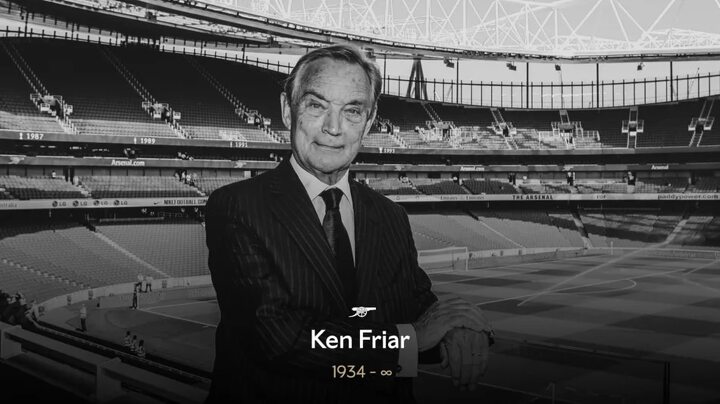
Arsenal has sorrowfully announced the passing of its life president, Ken Friar. Since the club's establishment in 1886, many inspiring figures have driven its progress, but none has had such a profound impact on Arsenal Football Club as "Mr. Friar." He leaves behind an extraordinary legacy of service to the club, a legacy that will remain unmatched.
Born on August 13, 1934, in Islington, Ken Friar joined the club shortly after World War II. Remarkably, he was involved in the club's operations across nine decades, truly embodying the living history of the club he loved and represented so brilliantly.
Kenneth John Friar's initial connection with Arsenal is a story worth retelling. In 1945, 11-year-old Ken was playing football with friends on Avenell Road outside the Marble Halls at Highbury when their tennis ball rolled under a cart. A voice from across the street called out, "What are you doing, son?" It was Arsenal manager George Allison, who called Ken over and told him to come back the next day. Young Friar did as he was told, and his enthusiasm impressed Allison, leading to a job running errands and delivering messages from the front door to the ticket office for half a crown a week.
Five years later, in 1950, after graduating from Highbury County Grammar School, Arsenal offered him a full-time position. Although Ken wanted to pursue an apprenticeship as a stockbroker, which offered higher pay, his parents preferred the stability of working for Arsenal. Ken joined the ticket office as a junior clerk.
Ken was intelligent, sharp, and good with people, able to deal with everyone from ordinary supporters in the stands to the prominent figures on the board. In 1965, he became assistant secretary to Bob Wall, truly beginning to understand how every aspect of a football club operated. In 1966, Highbury hosted the world heavyweight championship fight between Muhammad Ali and Henry Cooper, in which Ken played a crucial role—he often listed it as one of his career highlights. In 1973, he became club secretary, establishing himself as a key figure at Arsenal and one of the most respected administrators in football. In 1983, he was appointed managing director, further enhancing his standing at the club and in the football world.
By this time, Ken was effectively running the football club, presiding over a transitional period that led to the trophy-laden George Graham era. He delightedly watched the Gunners return to the pinnacle of football under a manager he had known since the manager's arrival as a player 20 years earlier.
However, this was also a period of immense challenges for senior figures in football, including the ever-present problem of hooliganism, proposals for an ID card system for all fans, and the need for major stadium renovations. Discussions about leaving Highbury had been ongoing for decades, and Ken was involved in negotiations that could have seen the club move to Wembley, Alexandra Palace, or elsewhere. In 2000, his foresight led him to transition into a new role, serving as a director responsible for the club's relocation from Highbury to the new stadium at Ashburton Grove, just a stone's throw away.
Ken was the ideal person to drive this massive project in his native Islington, working alongside his long-time friend and fellow director, Danny Fiszman. He worked tirelessly, with immense passion and diplomatic skill, to ensure every step went smoothly and every obstacle was cleared, until the stadium opened on time and within budget in July 2006.
His close ties to the Royal Family led to Her Majesty the Queen's planned attendance at the official opening of Emirates Stadium. Due to the Queen's illness, the Duke of Edinburgh officiated the ceremony instead, and Ken was subsequently invited to Buckingham Palace with the entire men's first team to meet the Queen. This was another career highlight.
This magnificent new temple of football proved a fitting stage for another trophy-winning team, managed by another dear friend and inspiration, Arsène Wenger. For about a decade thereafter, Ken continued to shape the club's direction as a board member, using his unique local diplomatic skills to ensure that relations with the council remained productive and mutually respectful. Indeed, it's hard to imagine anyone more deserving of the Honorary Freedom of the Borough of Islington award he received in 2004.
He accepted this honor, as he did his OBE for services to football in 2000, with humility. In 2014, when the South Stand bridge was renamed the "Ken Friar Bridge" and accompanied by a statue depicting Ken as the young football enthusiast about to have his fateful moment on Avenell Road, Ken again tried, unsuccessfully, to downplay his immense influence at the club.
In 2020, Ken stepped down from his executive director role and was appointed life president. His involvement with Arsenal became less hands-on, but he would still arrive early for matches and attend to various club matters. It was during this time that he lost his beloved Gwen, a devastating blow to Ken and his family after more than 60 years together.
He will be unforgettable to all who knew him, whether they were players whose contracts he meticulously explained, local councilors he calmly and powerfully persuaded of the club's value to the borough, or staff who enjoyed hearing his precious stories accumulated over decades. But most importantly, he will be remembered by his family and close friends, who loved him as a kind, generous, and wonderful father, grandfather, and friend.
Ironically, Ken Friar likely wouldn't want people to dwell on his life's achievements, as he deeply embodied Arsenal's motto of "Always Forward." His belief that "tomorrow's game is always the most important" did not allow for excessive reflection on the past when there was an important future to face. But it's hard not to reflect on the fact that in 1945, when he walked through the gates as an Arsenal employee on matchday at George Allison's invitation, he would sneak down the tunnel for a glimpse of his heroes playing on the hallowed Highbury turf. That team still featured Cliff Bastin and George Male, great players from Herbert Chapman's invincible Arsenal team of the 1930s.
More than 75 years later, with his 13th league title in his lifetime, he still enjoyed every moment of seeing Arsenal players conquer all, making our name shine around the world—something we could not have done without him.
At this difficult time, we stand with Ken Friar's family and many friends.
AF's PC site is now live! Browse full news, comments, match details and stats on your computer. Visit: www.allfootballapp.com
 Arsenal
Todos os comentários (13)