
Thiago returned to Liverpool's AXA Training Centre to chat with head coach Iraola in an official club programme. The two discussed the transition from player to coach, coaching philosophy, player management, and the impact of Anfield's atmosphere and fan support. This is the first part of an exclusive interview.
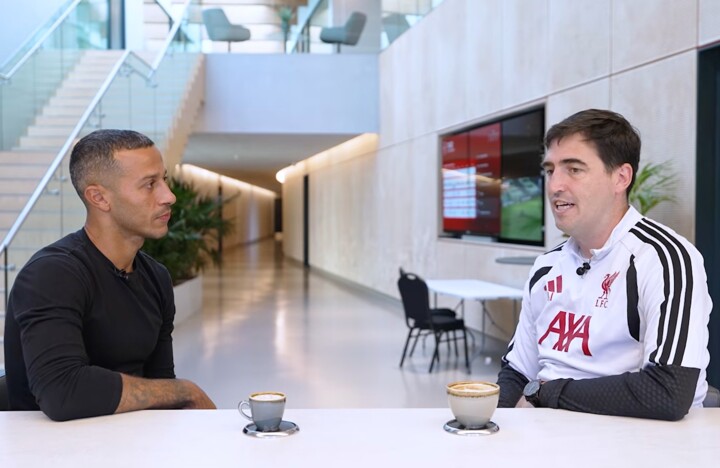
Thiago: Andoni, thank you for letting me watch the training session. It's been great to see firsthand how you run your sessions. When I used to play against your Bournemouth side, I found it quite challenging. Now I finally get to see how you prepare these training sessions.
Iraola: Today's situation isn't ideal because there's an international break and we only have eight players here. But honestly, they're training really well, truly very well.
Thiago: For us, there's been a big change here. When we used to come to the AXA Training Centre, we'd just pass through, but now there's a coffee area. I think some players might be late for physio or training because they'll linger here.
Iraola: I think it's a place everyone loves. When you walk in, you'll see Mac Allister and the others having their first coffee of the day. We usually arrive before the players and work here first. Then you'll hear the players laughing and chatting here. I think it's a very comfortable space.
Thiago: Exactly. We've all been players, so of course we understand the game, but being a coach involves so much more—things like training loads and coordinating with the medical team.
Iraola: I think after you finish your playing career, you have to remain very humble. You gradually realize that watching matches, analysing them, and preparing training sessions is one thing, but you also have to learn how to actually do a coach's job.
You have to organize training, consider how many players can participate, and prepare different plans. What if one player gets injured? You have to adapt quickly. Another player gets injured, and you have to find another solution. All of this requires experience.
Thiago: Back when we were playing and training, sometimes we didn't understand why we'd start with a small-sided game and then expand the space so everyone could run. We'd say, "Okay, why like this? I don't feel like running this much today." But actually, before the session even starts, the coach has already considered so many things.
Iraola: Yes. And you have great people around you. I think that's the key: in this area, you want to surround yourself with people who know more than you do. You can learn a lot from them and gradually learn to understand the data. How many players are running? How many high-speed runs are they doing? Are we asking too much, or too little?
You have to constantly seek balance, even making adjustments during the session itself. Maybe the plan was two sets of eight minutes each, but you see they're not running enough, so you change it to three sets of eight minutes. Or you do just one set, because continuing could injure them. That's probably one of the most demanding aspects.
Thiago: We were teammates and from the same country, and we were together in Spain's national team too. We followed your career when you were coaching in Spain. The teams you managed kept improving, you made them better, then you came to the Premier League. But there's always a moment in life when you start thinking, "Okay, maybe I want to be a coach." Because the level you're at now isn't something that happens overnight; it's accumulated step by step, isn't it?
Iraola: Yes. Back then, I wasn't entirely sure I wanted to be a coach. I wanted to try, but I hadn't fully committed. I think that actually worked in my favour, because I was prepared to make mistakes. I might even say I almost expected to fail. Then I would have said, "Okay, I tried, but I'd prefer to do something else."
But I think doing this job every day makes you want to keep improving. Now that I'm at Liverpool, you might think my coaching career has always been on an upward trajectory. Actually, it hasn't always been that way. Overall, it's probably been upward, but along the way, there have been ups and downs, then ups again, then downs again.
It's actually at those lowest points that you learn and develop, making yourself better for the next time. Then you can move forward step by step, keep improving, face more challenges, and handle more difficult things. But everyone has these moments in their journey. Ask any head coach, even the most successful ones, and they've definitely thought at some point, "This job isn't for me."
Thiago: Of course. I can imagine that, because as we said earlier, this job demands so much time and effort. Looking back at the coaches you've worked under, whose influence do you see in yourself now as a coach? What makes you think, "I adopted this approach from that coach," or "he inspired me to do this or that"?
Iraola: I think as a coach, we take many things. We absorb things from others.
Thiago: Football wasn't invented by us.
Iraola: Exactly. For example, you go to a training session and think, "This is good, I like what I see here."
Then you think, "I'll try to do something similar," or make some adjustments based on that.
The same goes for coaches we've worked with before. If you ask me to name someone, I always refer to Valverde. I know you know him well too. Sometimes we look at a head coach and think they must be very special, they must be a leader, they must have everything. But sometimes, you just need good judgment and do what's best for the team, for the whole group. I think Valverde has many of those qualities, and I try to apply them.
Thiago: If we look back, say coach Andoni is sitting here now with me, and then your player version also comes and joins us for a flat white. How would that player look at who you are now as a coach?
Iraola: I hope he'd like our gym, our culture, and our style of play. But from another angle, I think player Andoni would probably struggle. Because my physical qualities weren't that great. You played with me, you know that physically I probably wasn't the best. In that situation, to succeed at a high level, you almost have to make the right decision every single time. So with our current model of play, I'm not sure my player version could handle those demands.
Thiago: I've watched you coach and I've watched you play. If I had to describe what it would be like to put your player self into your current team, I'd say you have one of the most important qualities a player can have: consistency. For a coach, the most crucial thing in a player is reliability.
Iraola: Exactly right.
Thiago: Yes, and you were that kind of player. You were a captain. I'd even say you played nearly a thousand matches. So I think that's precisely why you'd fit this team now. You can trust that captain, trust that leader. For me, that matters. And I think it's the same for you as a coach now. Players and the club can trust you, because you're that kind of person.
Iraola: Without that... I don't know, take you as a player. Honestly, among all the players I've worked with, I can barely think of anyone—if anyone at all—who's technically better than you. Everyone who's ever played with Thiago would say, "Your technique is truly exceptional."
Most of us players don't have one ability that really stands out. So we have to be consistent, ready every day, and always prepared to play wherever the team needs us. We have to keep working hard. I think that's invaluable to a coach. Now, you really appreciate a player like that: I might not have played them yet, but they still come here and train like today.
Some of them haven't played a single minute, but they still give everything in training. Players like that are treasures for a club, and they're hard to find.
Diterjemahkan oleh AI.
Situs web AF kini hadir! Lihat berita lengkap, komentar, detail pertandingan, dan statistik di komputer Anda. Kunjungi: www.allfootballapp.com
 ลิเวอร์พูล เอฟซี
 เตียโก อัลกันตารา
 เอร์เนสโต้ บัลเบร์เด้
 อันโดนี่ อิราโอล่า
ความคิดเห็นทั้งหมด