Liverpool's official website published an autobiography by Ian Rush, in which Rush recalled his experiences joining Liverpool and nearly being placed on the transfer list.
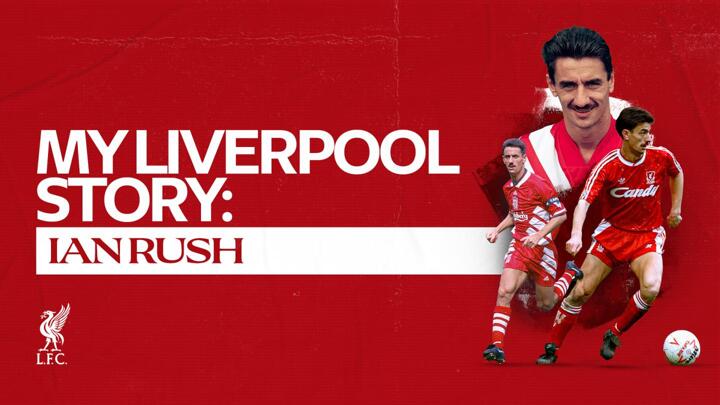
Official website content
My career at Liverpool is well documented, and fans probably already know my journey from a young boy in Chester, signing with the club and becoming the Reds' greatest goalscorer with 346 goals. I have great pride and am grateful for that journey.
So this time, I want to deviate a little from my usual columns and share some stories you may or may not have heard.
The reason I signed with Liverpool was because of Chester's manager, Allan Oakes. He understood my style of play. I think when Liverpool approached me, they offered £300,000 for me. Manchester City was also interested and actually offered £500,000.
Allan had played for Manchester City before, so you'd think he might have pushed me there, but he sent me to Liverpool because he felt it was a better fit for my long-term development. It must have been a difficult decision for him at the time, with so much money involved in that transfer.
But at Manchester City, many players would be thrust into the first team immediately, whereas at Liverpool, you'd have time to adapt, adjust, and learn. I'm very grateful to him because that advice really honed my skills as a striker and goalscorer, and shaped my later career.
I was only 18 when I joined Liverpool, and the club essentially told me that as a young player, I had two years to break into the first team. You could make mistakes in the reserve team and then learn to correct them and play Liverpool's way.
I made my debut shortly after signing and was also in the squad by the end of the season, after just five or six months. I played in the League Cup final replay and also in the European Cup semi-final against Bayern Munich.
By that point, I was eager to be in the first team the following season, so I went to speak with Bob Paisley to ask for a pay rise because I felt I was already a first-team player. But he refused, so we had a row and, in a fit of anger, I demanded to be put on the transfer list! He said that was fine and immediately challenged me.
He asked how many games I'd played, which was about 7 at the time, and he pointed out that I hadn't scored a single goal. But because we won the games I played in and I performed very well, I felt that said something. He said he'd put me on the transfer list, and so he did.
In response, I began playing with fire, wanting to leave Liverpool. First I scored two goals in the reserve team, then I got an opportunity in the European Cup match against Finnish side Oulu. We were already winning 4-0, Bob brought me on, and I scored an easy goal in front of the Kop – that was my first goal for Liverpool!
He then played me in two matches against Exeter, and I scored in both; then I scored two more against Leeds United, meaning I'd scored 7 goals in about three games. After that, Bob called me and said he'd give me the pay rise I wanted. So I asked him if that meant he'd take me off the transfer list. He told me I was never on it in the first place! It was a stroke of genius to light that fire in me.
When I arrived at Liverpool, I was actually very shy. I was only 18 and I remember getting dressed in the dressing room, sitting next to Ray Clemence, Alan Hansen, and other players I'd only seen on TV before.
I was very nervous at the time, but as I settled in, I realized I was as good as them. Bob Paisley would often call me to train with the first team one day on Thursdays, and then I'd go back to the reserve team on Saturdays. I think he quickly realized that being around stronger players elevated my own game to their level.
I remember the first time the Kop sang my name, I was too nervous to wave back. It was Sammy Lee who told me to acknowledge them! Once the match started, most of the time I was focused on everything on the pitch, and rightly so. But as you gain more confidence, start scoring goals, and the fans sing for you, you slowly fall in love with that feeling.
I always remember, the day I signed, standing in front of the Kop and thinking that if they sang my name just once, I'd have done well. Becoming the club's greatest goalscorer was something I never dreamed of. If I'd known then what would happen next, I'm not sure I would have believed it.
I always thought my job was to score goals. If I scored one, I wanted to score a second, a third, and so on. Every time you see the fans in the Kop smiling after you score, you crave that feeling repeatedly. That's the key. It was never about how you scored, but that you scored.
Now that I'm retired, looking at my entire career more broadly, I'd probably say that the most important goal I scored for Liverpool was my first one. I don't have a particular favorite goal, but that one gave me the confidence to keep doing the same thing repeatedly.
Of course, I scored more beautiful goals and played more brilliant matches. But if that goal had never happened, none of the things that followed would have happened either. That's football; the difference is often marginal, and the key is to take your chance when it comes.
The best trophy I won at Liverpool, and there is no other, was the 1986 FA Cup. As a child, I dreamed of scoring the winning goal in an FA Cup final. TV coverage usually ran from 9 a.m. to 5 p.m. Every year I'd watch the final and then immediately run to the backyard, pretending I was the one who'd scored the winning goal that day.
Thinking about what else I'd won before that – league titles, League Cups, two European Cups – I'd won almost everything. But the FA Cup, I never thought I'd have it in my hands!
But my dream really did come true: we beat Everton, and I scored two goals at Wembley. That's something I'll never forget. Now, when I talk to children, I always tell them to have dreams and believe in them. You have to work for it, whether it's football or something else, but dreams really can come true. My dream came true, so why not yours?
Everyone knows about my time at Juventus. But actually, I almost signed for another Italian club, Napoli. They had just signed Diego Maradona, and Maradona actually asked the club to sign me. I only found out about all this later when I spoke with him – he'd already started training and passed away shortly after.
That summer, after the season in which I scored 47 goals, Napoli made an offer of £4.5 million for me plus a £1 million signing bonus! But Liverpool simply refused.
To be honest, it shook me, purely because at the time I had the opportunity to financially secure my family. I had a big disagreement with President John Smith because he wasn't even willing to discuss it with me, and we probably didn't speak for about a year afterwards, mainly because we were both stubborn! But he really did have my best interests at heart, and I knew that. Napoli ended up winning the league title that season.
Later, I went to Italy, joined Juventus, and was happy. But I quickly realized that the outside world wasn't necessarily better. I had no idea then that I'd have the chance to return to Liverpool.
When it became clear I was leaving again, many clubs were interested in me. Manchester United manager Alex Ferguson called me, Everton was interested, Rangers manager Graeme Souness contacted me, and Bayern Munich also called.
But looking back at that experience now is interesting, because when Kenny Dalglish called me, he simply told me he'd booked me a flight for the next morning, and that was it. I didn't even discuss wages or anything like that with him. I just wanted to wear that shirt again.
Having the chance to return meant a lot to me. When you're away, you realize that playing for Liverpool means you're really spoiled. In a sense, I was a boy when I went to Juventus, and I returned to Anfield a man, and the rest, as they say, is history.
Traduzido por IA.
O site do AF já está online! Acesse notícias completas, comentários, detalhes de partidas e estatísticas no seu computador. Acesse: www.allfootballapp.com
 Liverpool
 Manchester City
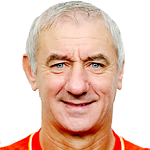 Ian Rush
All Comments